
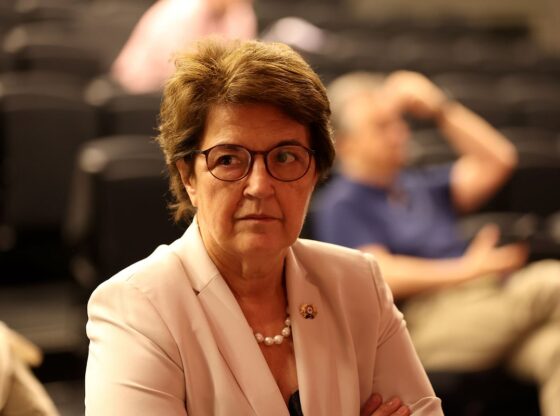

And in this sense, the pediatrician, who was also president of the Regional Health Administration of Lisbon and Vale do Tejo, recalls that in the State Budget for 2026 (OE2026) for the Health sector, a 10% cut is foreseen in the acquisition of goods and services item and that it is necessary to know how this will be done. In his opinion, he reinforces, having to have better management of health funds could even mean “a cut in labor work, the expense of which does not fall under the heading of human resources, but precisely under the acquisition of goods and services”.
At least, he emphasizes, “that’s my reading, because the SNS is spending millions on installment work of service, especially in emergencies, and I consider this to be a bad management practice”.
Firstly, because “the workers are not included in a team, they are hired to fill holes in the emergency schedules, and many of them are doctors without specialization, where there can be more insecurity in the activity, leading to an increase in the request for diagnostic tests, which immediately increases the expense of a service”. And he justifies: “What gives security in the operation of an emergency are the teams, and only by working as a team is better management possible.”
For this reason, Ana Jorge agrees that “there must be task-based regulation”, but with one condition: “the rules will have to be followed by all units, without exception, even running the risk of sometimes assuming that there will be a day when they will not have complete teams or sufficient personnel”. If this is not done, “there will always be gaps, because then the workers know that one hospital will not accept their services under certain conditions, but that another will give in”.
Remember that, and as has already been announced, the number of doctors on duty has doubled in recent years – from around 400, in 2019, to 4000, in 2025. Last year alone, more than 230 million were spent on hiring them.
Better medication management and more dialogue
But within the scope of reducing expenditure, the former government official also argues that “better management in the area of medicines and good negotiation regarding their prices could reduce costs in this item of goods and services, of course”.
On the other hand, Ana Jorge highlights another measure that has already been approved, which is the creation of a unit to combat fraud. “In my opinion, fraud is more related to the acquisition of services and goods and if we had an acquisition process with more transparent, stricter and faster rules, which would make tenders more profitable, perhaps it would be possible to achieve more efficiency in the system and less fraud, resulting in some savings”. But, he emphasizes, “these are processes that have to be monitored to avoid such situations [de fraude]”.
For the doctor, who is already retired, the principle of health management should be to “manage better”, but without affecting “the care activity”. In other words, without affecting user care. It may be a “complex task”, as he says, but “it is fundamental”, reinforcing: “If there are cuts, they must be made surgically”, as “it is not understandable, at this time, when waiting lists are increasing, that any savings or cost reductions are made in a way that affects users”.
The former minister of the portfolio who is now supervised by Ana Paula Martins recalls that in her time, in 2010, “there was a budget of ten billion euros and now it is almost 18 billion. It is a very large amount of money and has to be well managed”.
In his opinion, money management in the health sector “is not linear”. “There are many variables. And when you think about making changes you have to think as a whole, you can’t put out fires here and there, because the blanket is short. And changes can only be achieved when they are discussed and have the participation of professionals who are on the ground. It would be easier if they were also heard, and not taking measures that seem to me to be being imposed”.
Doctor Ana Jorge, a specialist in pediatrics, was one of those who worked in the periphery, having then worked for 15 years at the D. Estefânia hospital and having been director of the Pediatrics Service at Garcia de Orta, before going on to hold political positions.