
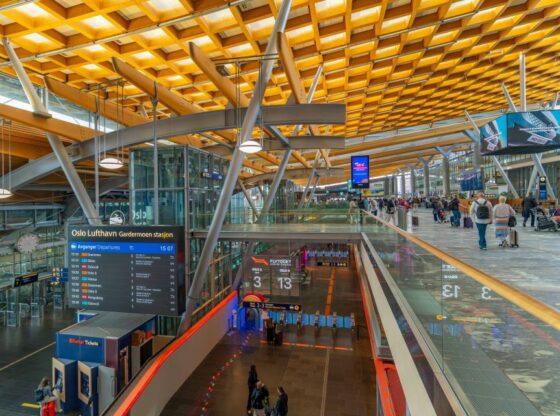

OSLO Airport has been shut after a drone was spotted circling its airspace late on Monday night – the second Scandinavian locale to shut in just hours.
Police confirmed the sighting just before 11pm local time, with several incoming flights forced to divert to Bergen, Stavanger and Kristiansand.

6

6
At 12.30am, operator Avinor announced the entire airport was closed following a second drone sighting.
Press Officer Karoline Pedersen Customs Local Outlet NRK: “This means that flights that are now coming in will be redirected to the nearest airport.”
Security services are on alert, with police deployed at Gardermoen and the domestic security service PST kept updated “continuously,” according to senior advisor Eirik Veum.
Operations manager Gisle Sveen said officers were “taking measures to try to locate this drone” but had not yet tracked down the operator.
The closure in Oslo came just hours after Denmark’s biggest airport was also brought to a standstill by rogue drones.
All traffic at Copenhagen Airport was halted after drone sightings in the airspace at around 8.30pm on Monday.
Copenhagen Airport said early on Tuesday it had reopened after traffic was halted for about four hours.
“There will be delays and canceled departures. Passengers are requested to stay informed through their airline,” read a statement on X.
The airport was closed after between two and four “large” drones were seen in the area, according to a police spokesperson.
At least 35 flights had to be diverted to other locations.
Flights that were due to land in Copenhagen were instead forced into holding patterns or rerouted to other hubs across Denmark and southern Sweden, leaving thousands of passengers stranded.
One flight was allowed to touch down at Kastrup after running critically low on fuel, but most were diverted to Billund, Malmö, Gothenburg and even Ängelholm.
In a police statement earlier released on social media, a spokesperson said: “[The airport] is currently closed for take-off and landing”.
Danish media reported helicopters were seen in the airport.
Two people were also arrested in Oslo shortly after the drones were spotted.
The two incidents are not yet believed to be linked.
Frustrated travellers reported confusion both in the air and on the ground.
Passenger Mikael Belstrup told TV 2: “We were told that Copenhagen Airport was closed due to drones and that the staff didn’t know anything.
“We are still in the plane and they are refuelling it so we have the opportunity to come back if or when the airport opens.”
Others described seeing police cars racing around the runways and “blue flashes” from the tarmac as emergency crews responded to the scare.
This isn’t the first time Copenhagen Airport has been paralysed by rogue drones.

6

6
Back in January, the airspace was closed for nearly two hours after similar sightings.
At the time, military analyst Rasmus Ross warned that security gaps make it difficult to trace or neutralise drones.
“You don’t have a complete system that can register what is flying in the air, who is flying, and what their intentions are,” he told TV 2.
The mass disruption came as Europe has grown increasingly jittery over drone activity near critical infrastructure – with airports, military bases and power stations all on heightened alert.
Experts warned that the disruption is part of a much bigger problem hitting Europe’s airports.
Across the continent, terminals have been battling crippling cyber attacks that forced check-in systems offline and left passengers stranded.
Heathrow, Brussels and Berlin were all thrown into turmoilwith airlines forced to fall back on paper-based workarounds to get travellers boarded.
The EU’s cybersecurity agency confirmed malicious software was used to lock airport systems, saying: “The type of ransomware has been identified. Law enforcement is involved to investigate.”
Ransomware is a weapon of choice for criminals — infecting key systems before demanding bitcoin payments to undo the damage.
But intelligence experts believe this latest wave of chaos bears all the hallmarks of a state-backed hit job.
Security and politics expert Anthony Glees told The Sun: “Without doubt, the Russians are behind these attacks on airports in London, Berlin and Brussels.
“No one can doubt that Putin’s strategic planners are the beneficiaries here because they have been able to demonstrate they can attack our cyberspace with impunity and at will.”

6