
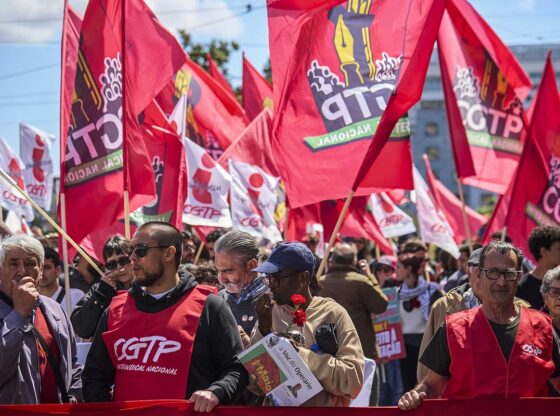

CGTP hopes that the national demonstration that will take place on Saturday, November 8, in Lisbon will be “a great moment of denunciation” and affirmation of workers’ struggle against the Government’s draft labor review.
Under the motto “All to Lisbon”, the demonstration called by the trade union central led by Tiago Oliveira, scheduled to start at 2:30 pm on Saturday, foresees two pre-concentrations in the capital: public sector workers will come together in Amoreiras and private sector workers in Saldanha, both of which will “flow into” Marquês de Pombal.
Speaking to Lusa, the secretary general of the General Confederation of Portuguese Inter-Union Workers (CGTP) hopes that this will be “a great moment of denunciation” and “a great moment of affirmation of the workers’ struggle” against the draft reform of labor legislation.
“It is now necessary to send a signal to the Government that it has to back down in the construction of the labor package”insists Tiago Oliveira, considering that the draft “is profoundly negative for the world of work”.
Also remembering the demonstrations in Lisbon and Porto on September 21st and the Public Administration strike on October 24th, the CGTP general secretary reiterates that the objective is to “bring workers to Lisbon” so that the “Government can look at what is the true extent of the indignation of the majority of Portuguese people” and remove the package from the discussion.
The executive “cannot be stuck in a one-dimensional reality”, without looking at “the concrete reality of millions of workers who go to their workplaces every day and they live off their meager salaries, the difficulties of day-to-day life, precariousness, the deregulation of working hours, the constant pressures that exist in the workplace”emphasizes.
To ensure the participation of workers who work on weekends, several strike notices were issued, namely in the “commerce, service sector, restaurants, hotels” and “some industries” sectors, says Tiago Oliveira.
The CGTP has been insisting that the Government’s draft represents “a real setback” in workers’ rights and points out that there are unconstitutional amendment proposals.
The Government’s draft revision of labor legislation, which is being debated with social partners, provides for the revision of “more than a hundred” articles of the Labor Code.
The changes foreseen in the proposal – called “Work XXI” and which the Government presented on July 24th as a “deep” review of labor legislation – range from the area of parenthood (with changes to parental leave, breastfeeding and gestational bereavement) to flexible work, training in companies or the trial period of employment contracts, also providing for an expansion of the sectors that will be covered by minimum services in the event of a strike.