
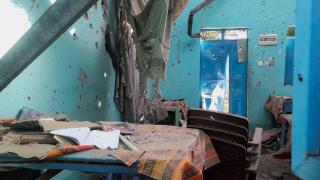

Last Monday the general Abdel Fattah al-Burhanleader of the Sudan Armed Forcesacknowledged that his men had had to withdraw from The Fasher –the capital of North Darfur and its last bastion in that part of the country – after battling for 18 months against the paramilitary group RSF or Rapid Support Forces. The loss, experts say, represents a turning point in the civil war that has been ravaging the African country since the spring of 2023.
Right now, what worries entities like the most United Nations This is what is going to happen to the local population. Nearly 300,000 people, according to the latest data. This concern has to do with the ways in which the RSF spends when they enter conquered territory. What’s more: according to the Yale University Humanitarian Research Laboratory The group has been carrying out “cleanup operations” since the weekend. Focused, above all, on the city’s non-Arab population.
Parallel to the concern of humanitarian organizations is the strictly military aspect. And when a few months ago the RSF were expelled from Jartumthe capital, some observers predicted the beginning of the end of the civil conflict. The loss of El Fasher, however, indicates that the paramilitaries are not only not on their last legs but that they still have enough capacity to go on the offensive.
The question, of course, is how. That is to say: why they have – or, rather, maintain – that capacity. The response of many experts: for the support it provides United Arab Emirates.
Chinese weapons and drones
It should be noted that the Emiratis have always denied having armed the Sudanese paramilitaries. However, the Wall Street Journal reported this Wednesday that the US intelligence services have not only certified their support for the RSF but have also detected an increase in it.
Specifically, and always according to the information to which the North American newspaper has had access, what US intelligence has observed is the sending of “a growing number of weapons, including sophisticated Chinese-made drones” to the group led by Mohamed ‘Hemedti’ Dagalo “since last spring.” That is to say: since the paramilitary militia had to withdraw from the capital and, consequently, began to lose ground.
The reports issued in Washington come from two different institutions: the State Department –equivalent to our Ministry of Foreign Affairs– and the Defense Intelligence Agency; a federal office linked to the Department of Defense of the United States.
Furthermore, at the beginning of August, Latin American media such as The Empty Chair They investigated the presence of hundreds of Colombians in the ranks of the RSF. Mercenaries, in short, who would have reached Hemedti’s forces through the United Arab Emirates and also thanks to Emirati money. These mercenaries, the journalists of The Empty Chairwere not only in Sudan as combatants but also as instructors.
The statements of the Latin American newspaper forced the president of Colombia, Gustavo Petroto promise an investigation into the matter that, as far as is known, remains open. The leaders of the Arab country, for their part, once again denied having anything to do with any Colombian mercenary.
“Sudan is the most recent example of how the wealthy Gulf state projects its power discreetly to influence the trajectory of conflicts that take place in strategic regions,” states the chronicle of the Journal.
The Emirati interest in Sudan, the same sources continue, is divided between two fronts: the economic one – Sudan has large gold mines – and the geopolitical one – enhanced by its access to the Red Sea. On this second front, what would be a matter of shoring up its relevance in the face of the interests of foreign powers aligned with Abdel Fattah al-Burhan: Egypt, Saudi Arabia e Iran.
It is worth clarifying, at this point, that the United States has not formally accused the United Arab Emirates of supporting Hemedti. For now, he has limited himself to condemning the role of “foreign actors” in the deterioration of the situation without offering proper names. Furthermore, and in line with the Emiratis’ refusal to be involved in the Sudanese conflict, the RSF has also denied receiving their help.
El palo y la zanahoria
Emiratos Árabes Unidos, socio clave de Estados Unidos en el mundo árabe, tiene fama de mediador en una región dominada por la incertidumbre, las tensiones y, en última instancia, las guerras.
Los emiratíes ayudaron, por ejemplo, a sellar los Acuerdos de Abraham durante el primer mandato de Donald Trump logrando, así, que varios países árabes establecieran relaciones diplomáticas con Israel. Y también han contribuido –por citar un segundo ejemplo– a los planes de paz estadounidenses para Gaza.
En otras ocasiones, sin embargo, los intereses del país del Golfo pasan por defender facciones concretas en guerras civiles. Se sabe que intervino en Yemen para combatir contra los hutíes y, según el Journal, también ha suministrado armas a una milicia libia respaldada por Rusia.
Esta segunda faceta, que es la que predomina en la guerra civil sudanesa, está frustrando a muchos en Washington. “La guerra habría terminado ya de no ser por Emiratos Árabes Unidos”, declaró hace unos días Cameron Hudson; ex jefe de gabinete de varios enviados especiales presidenciales estadounidenses en Sudán. “Lo único que los mantiene en esta guerra [a los integrantes de las RSF] “It is the enormous military support they receive from the Emiratis.”
The Arabic version is below 👇
Escaping El Fasher: A survivor’s tale
Hayat Yaqoub Hussein, a survivor of the El Fasher battles, tells Ayin about the first moments of the attack by the Rapid Support Forces on El Fasher after arriving with dozens of displaced people in the Tawila area.
It… pic.twitter.com/55ONrb22LI— Ayin Network – Ayin Network (@AyinSudan) October 28, 2025
Humanitarian tragedy
The Sudanese civil war began two and a half years ago. When the rivalry between generals Abdel Fattah al-Burhan and Hemedti, until then allies, led to a conflict over the control of the country’s natural resources.
Since then, several foreign powers have contributed weapons and financing to the conflict, including mercenary groups composed of the aforementioned Colombians but also Russian soldiers.
All of the above has generated one of the greatest tragedies on the planet. Because the war has not only claimed the lives, directly, of 150,000 people but has also pushed millions to the doorstep of an unprecedented famine.
To this we must add several medical epidemics in rear areas – such as the capital itself – due to the deterioration of all types of infrastructure. There is talk of the dreaded cholera and, also, the dengue virus.