
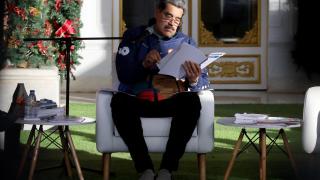

It would not be a decision Nicolas Madurobut given the good relations he has with the lifelong Ottoman leader, Recep Tayyip Erdogan, Türkiye It would be one of the most likely destinations for the Venezuelan dictator to go into exile, according to leaks from Donald Trump’s team – collected by the media Politico-, who has been putting pressure on the Venezuelan for weeks with his Operation Southern Spearillegal attacks on what he calls “drug boats,” which have left at least 80 dead.
There are other possible destinations, such as Russia, Cuba or even Azerbaijanbut Ankara emerges as the most likely, for several reasons: the close relationship between Maduro and Erdoğan, economic interdependence and the use of Istanbul as a hub financial where Maduro evade economic sanctions. There is also the Turkish experience in hosting actors repudiated by the West and a reasonable protection capacity in a country that is a member of NATO, in the face of the fragility of Cuba or the risks of Russia.
In October, the New York Times revealed with anonymous sources in Washington and Caracas that discreet negotiations were being carried out in which the Venezuelan leader offered to open all current and future oil and gold projects to American companies (now only Chevron operates, with limits), with preferential contracts, redirection of crude oil exports from China to the United States, and reduction of energy agreements with Beijing, Tehran and Moscow. The objective was to avoid a military conflict with the US in exchange for a kind of “oil pax”.
Rejected the plan a few days later, the Venezuelan vice president Delcy Rodriguez contacted the White House – through Qatar – to offer a exit to Maduro in two or three yearswith resignation at the end of that period. Trump, whose impatience is legendary, refuted it because he considered it too long. With Trump’s haste, Türkiye would be the ideal place, although both Ankara and the Turkish official media remain silent.
Since the mid-2010s, Türkiye and Venezuela have boasted of an alliance of convenienceoh very intense anti-imperialist. When in July 2024 the candidate Edmundo González Urrutia supposedly won the presidential elections in Venezuela – despite which the National Electoral Council proclaimed Maduro’s reelection -, Erdoğan avoided aligning himself with the fraud narrative and maintained his support for Maduro, although more carefully than in 2019. The Turkish leader called his Venezuelan counterpart by phone in August to express his “good wishes for the Venezuelan people” and to reiterate his support for a “dialogue process”, in a much more discreet manner and avoiding explicitly congratulating him, according to Al-Monitoras he did in 2018, when he refused to officially recognize Juan Guaidó (unlike the US and the EU) and congratulated Maduro without nuances. Erdoğan then called the Venezuelan “brother,” and his entourage launched the hashtag #WeAreMADURO as opposition to Western recognition.
For his part, the Chavista leader has publicly congratulated his “brother and friend Erdoğan” during his numerous re-elections as good news for Venezuela and for a “new post-Western world.” Both leaders share this victim narrative of living under the siege of Western sanctions and plots, so Erdoğan would assume the reputational cost of welcoming him, which would be beneficial for a domestic support that is going through its worst moment.
Venezuelan gold buyer
In this same context, while sanctions strangle Venezuela, Türkiye has become the main buyer of Venezuelan gold, with exports close to 900 million dollars in 2018, as revealed Bloomberg. Turkish companies are on Washington’s radar for their role in Venezuelan gold refining and re-export schemes, showing Ankara is willing to take legal risks to help Caracas dodge embargoes. Recent reports about him Istanbul Grand Bazaar describe how Venezuelan gold is mixed with flows from Russia and Iran, which use Türkiye as hub money laundering and evasion.
The two leaders have exchanged at least seven visits and reciprocal meetings, and even the Turk has received the Order of the Liberatorthe highest Venezuelan decoration. For his part, Maduro is a fervent admirer of Erdoğan and also of his Ottoman neo-imperialist narrative. The Chavista leader is a devotee of the series about the origin of the Ottoman empire Resurreccion: Ertugruland has visited the filming set in the Black Sea.
In 2022, Erdoğan boasted that bilateral trade had increased from 150 million (2019) to 850 million dollars in 2021with a goal of 1,000 million and then 3,000 million, and defined Venezuela as a “very important partner in Latin America.” In this line of prosperity, in 2018 Maduro was recorded eating luxury meat at the Salt Bae restaurant, in chef turco Nusret Gökçein Istanbul while his country was experiencing a humanitarian crisis, generating an international scandal.
Beyond the frivolous, a powerful image was forged, that of Istanbul as the scene of Maduro’s ostentation, a symbol of closeness and comfort. Türkiye already plays a similar role with other actors, since it has hosted the leaders of the Egyptian Muslim Brotherhoodand other Islamist opponents in the region, who operate from Istanbul relatively freely. Various leaders of the Palestinian Islamist organization Hamas (considered a terrorist group by the US and Western countries) have found a relatively safe place in Türkiye and Erdoğan has been publicly photographed with them. In another similar case, that of Halkbank with the Iranian businessman Reza ZarrabTürkiye demonstrated how it was able to lend itself to gold-for-gas exchanges to help Iran evade US sanctions. An exiled Maduro fits this pattern.
Why Cuba and Russia are more problematic
Türkiye is not the only option, but it solves things that Cuba and Russia complicate. In Cuba, despite the ideological affinity of the “sister revolution”, and with decades of experience hosting conflictive exiles such as ETA militants, and American fugitives as Assata Shakursuffers from structural weakness as it is economically at its limit. Welcoming Maduro and his entire entourage would represent a huge extra burden in a country with blackouts, shortages and growing protests. The island is also very physically close to the US and is extremely vulnerable to any additional tightening of sanctions or blockade if Washington decides to punish Maduro’s golden exile there. Symbolically, a Maduro refugee in Havana would consolidate the story of the “Bolivarian international” and could serve as an easy pretext for more pressure on Cuba.
But in addition, the Venezuelan crisis is sinking Cuba, with the collapse of the production of PDVSA, the Venezuelan state oil company: oil shipments to Cuba have been drastically reduced, which has increased blackouts and fuel crises on the island. Havana is terrified of Maduro’s eventual fall. And, for its part, in the Venezuelan Armed Forces there is resentment towards the weight of Cuba, with sectors that detest Cuban interference, and stories that they have too much power in intelligence, counterintelligence and presidential security, according to an analysis by the Wilson Center.
If the option were RussiaMaduro would obtain maximum protection, but also a high risk due to the volatile relationship between Trump and Vladimir Putin due to the invasion of Ukraine. Moscow also has a history of sheltering ousted former leaders, starting with the former Ukrainian president Viktor Yanukovych after the Maidan in 2014, to the former Syrian president Bashar al-Assad since December 2024. However, for Maduro, going to Russia would mean entering a much tighter sphere of control from the Kremlin: he would be totally dependent on Putin for everything, with less room for maneuver than in a pivotal country like Turkey. Furthermore, logistically, moving Maduro’s entire political, family, and business network to Russia is more complex and less natural than to a country where they already move freely through business (Istanbul) and political tourism.
From Washington, the Turkish route gains numbers, because Ankara is the uncomfortable but familiar friend: It has sufficient protection capacity for Maduro, it is a member of NATO (although it acts on its own, as demonstrated with the purchase of Russian S-400 or its pragmatic relationship with Iran), with a powerful security apparatus, and without the level of geopolitical exposure of Russia or the fragility of Cuba. That is, Türkiye offers a useful ambiguity.
For Trump, who also enjoys good relations with Erdoğan, allowing Maduro to stay in Turkey is a functional solution, distancing him from the Caribbean and the American continent, while maintaining some capacity for pressure through the NATO-Turkey relationship in case he wants to renegotiate his status.
in analyst Phil Gunsonof the International Crisis Grouphas warned about the dangers of violently expelling Maduro at a time when in Washington there is a feeling that the Chavista is cornered, with the largest naval deployment in the Caribbean since the missile crisis and the CIA’s authorization for covert operations in Venezuela. A peaceful transition to democracy would not be guaranteed, Gunson says. If Maduro’s fall is too rapid, perhaps there would not even be time to flee to Türkiye. But if the dictator leaves Miraflores on a plane, we could see him playing backgammon with Hamas leaders.