
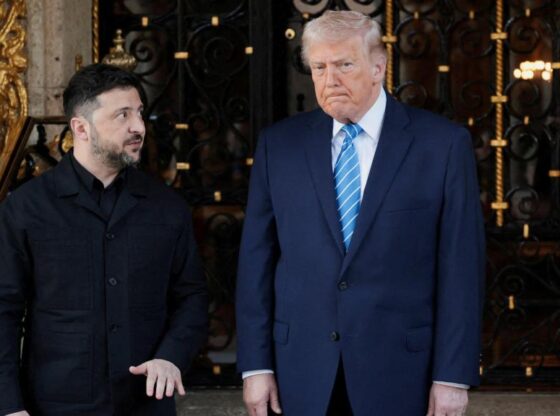

Despite the optimism expressed by Donald Trump after the meeting held this Sunday at his residence in Florida with the president of Ukraine, Volodímir Zelenskithe idea left by the meeting between the two is that the peace agreement with Russia – something that the American has been pursuing for more than a year – is not only not ready to be signed but, in addition, it may still take a long time to arrive.
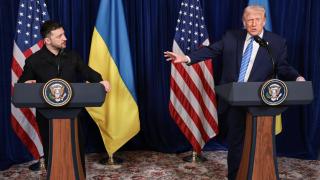
“I had an excellent conversation with Zelensky,” Trump commented during the press conference held at the end of the meeting. “We are 90% toward reaching an agreement,” declared the Ukrainian leader.
US President Donald Trump with Ukrainian leader Volodymyr Zelensky
If one reads the 20 points of the new peace proposal – the original one, agreed upon between the United States and Russia, consisted of 28 – and observes where there is still no agreement, the percentage offered by Zelensky is correct: only a couple of points would remain to be resolved.
The problem is that those two points are not anecdotal. Quite the opposite. What’s more: one of them – the one that affects the region known as Donbas – is vital for both contenders. For strategic but also symbolic reasons.
And, leaving aside the annexation of Crimea by Russia in 2014, the war that has pitted both countries since then had its origins precisely there: in Donbas.
Zelensky, experts say, cannot give up what Ukraine still maintains – 30% of the territory – without the risk of facing a citizen or even military revolt. And Putin, as explained by experts such as Mark Galeotti to EL ESPAÑOL, he can only sign a peace that he can sell as a victory in Russia. Something that would be very difficult with a pact that does not contemplate total domination of Donbas.
The other point on which there is still no agreement has to do with the Zaporizhia nuclear power plant. A facility on the banks of the Dnieper River, very close to the front line, but which has been in the hands of Russia since March 2022. kyiv would like to regain control of it to prevent, among other things, the Kremlin from using it against Ukraine.
Security guarantees
In another aspect that has always worried Zelensky, that of the security guarantees coming from the United States to prevent Russia from resuming attacks against Ukraine once peace is signed, there does seem to be progress.
As reported Christopher Millercorrespondent of Financial Times in kyiv and someone with direct access to the Ukrainian president, the United States would have offered a 15-year security guarantee. Still, the Ukrainians want three times as long to deter future Russian aggression, or at least twice as long.
“The Ukrainian president has requested a guarantee of up to 50 years,” Miller wrote in the chronicle he later sent to his newspaper. “Zelensky reportedly told Trump that 15 years would be too short a time to deter Russia in a conflict that began with the annexation of Crimea in 2014.”
“I also told him that we would like to consider the possibility of 30, 40 or 50 years,” Zelensky added during the conversation with the reporter. At the time of writing these lines, the White House has not commented on the matter.
An alleged attack on Putin’s residence
After the meeting in Florida and the subsequent press conference, one question remained floating in the air above all others: what will be Putin’s next step? Speculation pointed to two possible paths: that of participating in the negotiations seeking to gain as much as possible from them or that of trying to boycott them.
Coincidentally, this Monday, one day after the meeting between Trump and Zelensky and the good words that the former said about the latter, Russia accused Ukraine of having attacked one of Putin’s residences with drones.
“It is a definitive step towards a policy of state terrorism,” Kremlin sources have declared. They also warned that the attack forces Russia to “reconsider the negotiating position.”
Zelensky, for his part, has assured that this alleged attack is “a complete invention intended to justify new attacks against Ukraine.” And also intended to justify to Trump not wanting to continue with the negotiations and, consequently, directing his anger in the other direction.
In fact, as reported just a few hours ago by the Russian news agency TASS quoting a government advisor named Yuri Ushakovupon being informed of the attack, Trump reportedly appeared “shocked and outraged” by the “insane” nature of the matter.

Yuri Ushakov and Vladimir Putin during the meeting with Steve Witkoff, with their backs turned in this photo.
Reuters / Sputnik
“Thank God we didn’t give them Tomahawks,” the White House tenant reportedly added, alluding to the long-range missiles that kyiv requested from Washington a few months ago.
It should be remembered, in the wake of the alleged attack against Putin’s residence, that this weekend, hours before the meeting between Trump and Zelensky in Florida, the Kremlin ordered the launch of 500 drones and 40 missiles – including those of the Kinzhal class – against kyiv. The result: one of the most severe attacks that the Ukrainian capital has suffered since the start of the war.