


Surreal. There is no other way to describe what happened in the last week with the so-called “Trump Plan” and its twenty-eight points for peace in Ukraine.
Beyond the fact that it was agreed almost to the letter with the Kremlin envoy, Kiril Dmitrievincluded passages translated directly from Russian and was only communicated a posteriori to the envoy of ZelenskyRustem Umerov, there are around the process an air of haste and bad manners which is striking in such a serious matter.
From the outset, Zelensky himself was told the plan twice: one, on the phone, in a conversation from Miami in which Witkoff and Kushner tried to explain point by point with a “hands-free.” The other, in person, with Dan Discroll, Secretary of the United States Army, in a kind of ultimatum that Trump himself would endorse hours later: “You have until Thanksgiving Day (Thursday, November 27) to say yes.”
The first thing that draws attention, beyond the abruptness of the forms and the evident partiality, which led to a text completely unaffordable for kyiv, It is the variety of names. This is a recurring problem in the Trump Administration: there are too many people doing too many things.
American tradition dictates that foreign policy, although it obviously depends on the president, remains in the hands of the vice president and the Secretary of State, with specific interventions by the National Security Advisor.
With Trump, everything is diffuse. Vance has never traveled to Ukraine, although it was, according to the Axios portal, who decided that the person in charge of communicating the ultimatum to Zelensky was Discroll.
The Secretary of State, Marco Rubio, who is also the National Security Advisor after the resignation of Mike Waltz in May, rarely deals firsthand with major negotiations and usually leaves that role in the hands of businessmen friends of Trump, such as Steve Witkoff and Jared Kushner.
The strange role of Marco Rubio
So, after the “Trump Plan” disaster rejected by Ukraine, rejected by European allies and viewed with disdain by the Kremlin itself, despite the fact that it follows the designs of its envoy Dmitriev, it is difficult to know what exactly the official position of the United States is on the matter.
In fact, one of the first things he did Rubio When he saw that it wasn’t going anywhere, he disassociate the White House from the memo: In conversation with the Republican senator, Mike Rounds, he assured that this was nothing more than a Russian “wish list” and that it only served as a starting point.
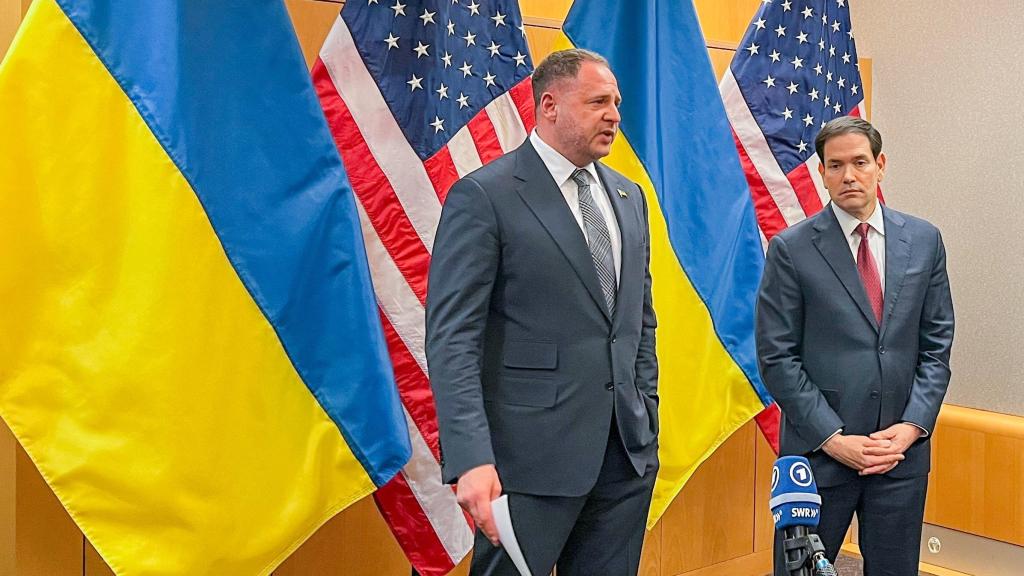
Andriy Yermak, chief of staff of the president of Ukraine, and Marco Rubio, US secretary of state; during their meeting in Geneva.
The curious thing is that this version of Rubio, which he has later denied repeatedly on social networks and in media interventions, clashes with Trump’s aggressiveness when setting dates and attacking the Ukrainian “leadership” on his social network, Truth, with unjustified violence.
Most likely Trump did not know what that memo contained and would like peace as soon as possible to join it with the other seven or eight that he says he has achieved during his mandate.
Now, How much did Rubio know? White House sources say that the Secretary of State “was informed” at all times of what was happening. It seems like a small thing for the highest representative of American diplomacy on a vital issue for the security of itself and its allies. Where was Rubio while Witkoff, Kushner, Dmitriev, Discroll and Umerov negotiated? It is not known.
The Geneva “sales”
His absence was so conspicuous and the diplomatic mess caused by Trump’s cohort so notable, that Rubio had no choice but to travel to Geneva to meet with a Ukrainian delegation and reestablish everything..
It must be remembered that Rubiowhen he was not a member of the Government, he was a convinced defender of the Ukrainian causesomething that Vance and Witkoff certainly were not.
So was General Keith Kellogg, who, in principle, remains the White House special envoy for the war in Ukraine, although we have not heard from him for a long time due to Moscow’s veto.
In Geneva, Rubio has dedicated himself to selling an optimism that is difficult to buy at this point and lowering all conditions for Ukraine. The 28 points have remained in 19according to the Financial Times, although it is not known which nine points so important as to have to be approved within a week have fallen by the wayside.
The ultimatum itself has come to nothing. Rubio no longer talks about Thanksgiving as a deadlinebut simply hopes that “everything will be resolved as soon as possible.”
Whatever this new revamped plan looks like, its application is as realistic as the previous one. It could be the case that the Ukrainian government, frightened by American pressure, ends up saying yes to one of these plans, which are nothing more than bread for today and hunger for tomorrow. What is not going to happen is that Putin accepts them. From time to time, every once in a while, he sends an envoy to negotiate something and the White House, anxious, buys his story. Then come the buts.