
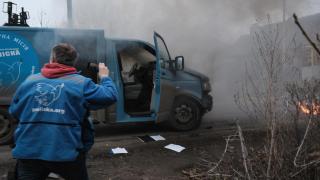

a huge white dove of peace -stamped on the hood- was the first thing you saw of the Proliska humanitarian mission vanin which they evacuated Ukrainian civilians trapped on the Donbass combat front.
It was seen tens of meters away, and indicated that it was the NGO vehicle. But on Saturday morning, that white dove of peace was used as a target by Russian drone pilots, who crashed into it – and into the civilians inside the van, including the El Español correspondent – an FPV drone loaded with explosives.
It wasn’t a coincidence. It wasn’t the first time either. The Moscow troops “hunt” with explosive drones to the Ukrainian evacuation teams for months. Also to rescuers, firefighters, ambulances; especially those who try to work on the Kherson and Donbas combat fronts.
Each FPV (first-person view) drone is piloted by a soldier who sees live everything that the unmanned aerial vehicle’s camera can record.
These pilots wear virtual reality glasses, and receive very clear images – especially if it is daytime – in which the target can be recognized in detail. Whether it’s a military man in a pixel uniform, whether it’s an old woman with shopping bags, or whether it’s an unarmed aid worker. Everything is distinguished.
So, when that Russian pilot saw Proliska’s blue van before his eyes, with the dove of peace stamped on the hood, and also saw how the vehicle braked violently and four civilians threw themselves from himknew that he was committing a war crime by hitting him frontally with the explosive charge.
Anti-drone networks
Proliska’s van had left since Kramatorsk an hour before being attacked by the Russian drone, and had to evacuate several civilians in four different directions within the city of Kostyantynivka – currently besieged by Russian troops, who are just three kilometers from the place.
The road to Kostyantynivka was calm. Almost the entire route was circulated under anti-drone networks that the Ukrainians are installing on all the front roads, precisely to stop these FPVs.
The two humanitarian workers were in the van. Evgeny Tkachev y Oleg Tkachenkoand Austrian journalist y the correspondent who signs these lines. And the evacuation mission was going according to plan.
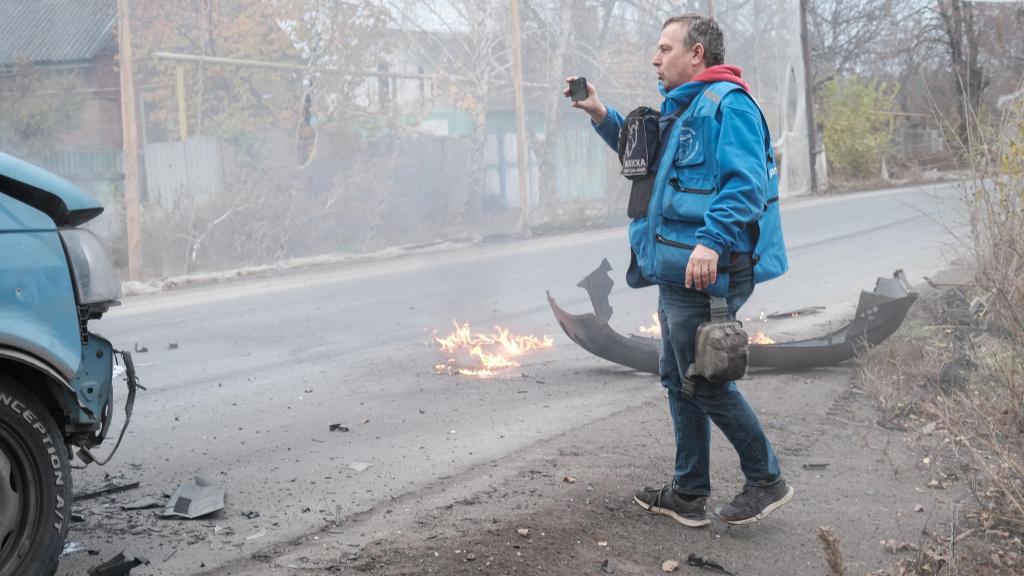
Aid worker Evgeny Tkachev documents with his phone the state of the Proliska evacuation vehicle moments after the Russian attack.
But upon entering the city, everything happened very quickly: Evgeny shouted “Drone!” and Oleg instinctively pressed the brake all the way. The unmanned aerial vehicle He was about 15 meters from the van, he was coming from the frontstaring at his prey. And the impact and detonation sounded like a sharp blow, while a smell of gunpowder filled everything in a few seconds.
Fortunately, a moment before the impact of the FPV all the crew jumped out of the vehicle. There were no injuries. Evgeny’s experience – who has been carrying out this type of high-risk evacuations since 2014, when the conflict in Donbas began – instinctively moved him to give the warning and open the doors as soon as he saw the drone.
When I looked again from the side of the road, the vehicle was covered in smoke. Despite being a armored van, the drone blew the engine. And the NGO was left without the means by which they took about 10 people a day out of this besieged city, where the train, the bus, or any other means by which they could flee from the war when it arrives at the doors of your house does not reach.
At this time there are more than 5,000 civilians in Kostyantynivka –most of them elderly–, and fewer and fewer humanitarian evacuation teams dare to enter, because now they have become a target for Russia. The result is that extractions occur in dribs and drabs, and people die there.
The Porkovsk 1,200
This attack also serves to answer some of the questions asked by those who follow the news about the war in Ukraine: Why don’t Ukrainians leave Donbas? Why are there 1,200 civilians left inside the city of Pokrosvk?
Pokrovsk is the other hot spot on the Donbass front, another city under siege where Not a single building is left unscathed.. Russia has massed more than 100,000 men at its gates, and is completely reducing it to rubble with its continued airstrikes.
It is almost a miracle that there is life in there, beyond the combat positions of the Ukrainian Army. But the truth is they remain 1,200 civilians trying to survive in basements – without electricity, gas, or heating – who remain there because there is no one to take them out, since Putin attacks the evacuation vehicles.
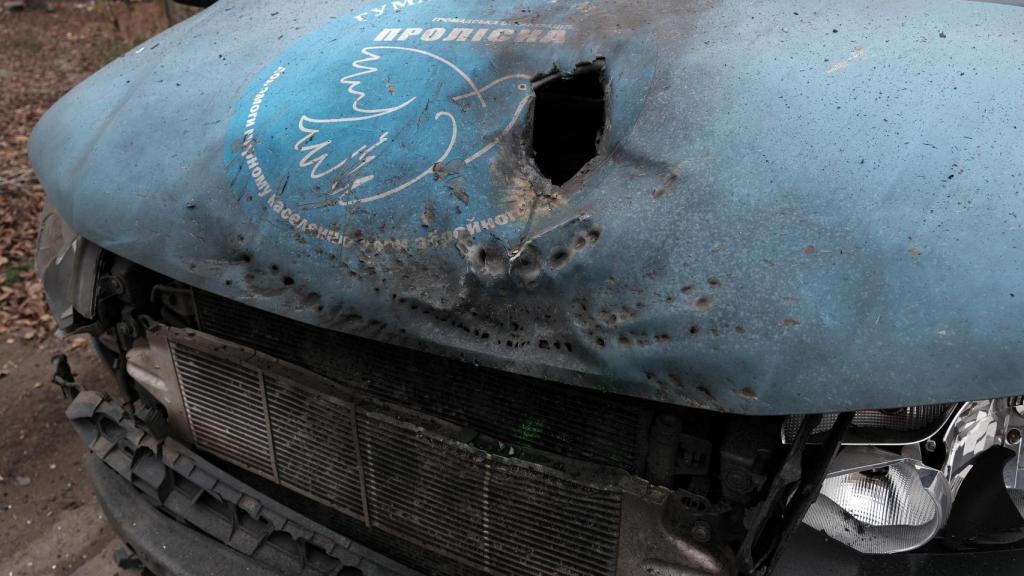
Impact of a drone launched by Russian troops against a humanitarian evacuation vehicle inside the city of Kostyantynivka.
These actions have a name: war crimes, which Russia repeats daily knowing it goes unpunished. Because it has been a long time since any government or international organization has raised its voice and demanded consequences. An impunity that has led to Putin to extend manhunts using drones –which he began performing in the city of Kherson– to the towns of Donetsk.
The Russian purges
Upon returning to Kramatorsk after the attack, Evgeny took a few minutes to assimilate what had happened. Sitting away from the others, he reflected in silence. Then he stood before the camera and explained what happened with unusual aplomb:
“Today during the attempted evacuation of the civilian population from Kostyantynivkathe car of the Proliska humanitarian mission was attacked with a Russian FPV drone with an anti-tank charge,” it said.
“Even though the vehicle was identified as a ‘humanitarian mission’ and the pilot was seeing it perfectly, the drone attacked anyway. Thank God we are all alive and healthy“We returned to Kramatorsk and we are going to continue organizing evaluations,” he concluded.
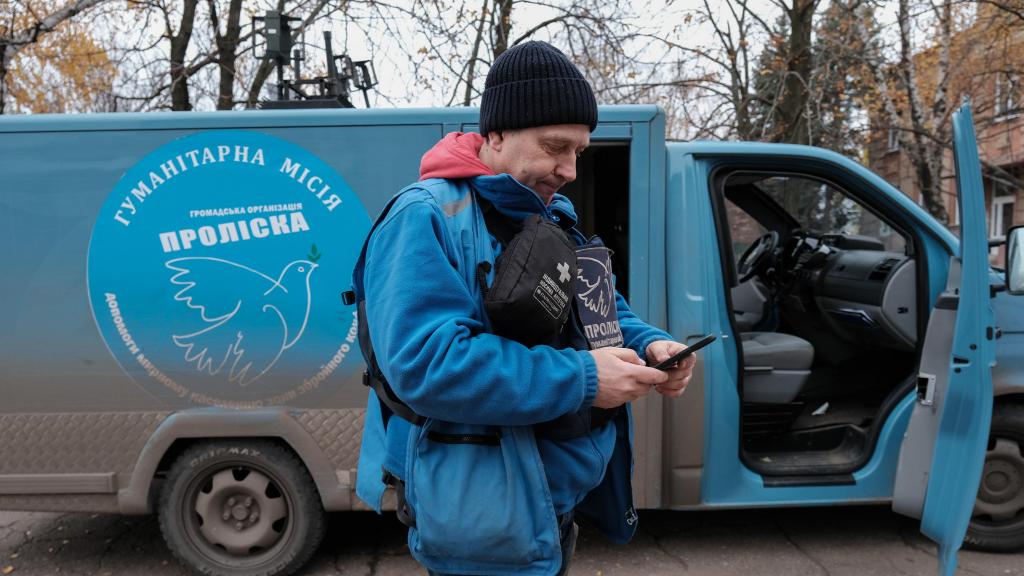
Evgeny Tkachev, a Ukrainian aid worker from the Proliska mission, next to the evacuation vehicle that would be attacked by Russia an hour later.
What Evgeny did not explain, but what the Ukrainian soldiers fighting on the front lines do say, is that the Russian troops in their advance through the Donbass They are killing the civilians who are trapped: “Generally civilians are killed, and They take only the children with them”says an officer on the ground.
“The same thing is happening in all the settlements that the Russian infantry is capturing: when they see an adult civilian is considered an enemy, and they shoot him on the spot.. For them there are no civilians.”
The systematic attacks against evacuation teams are a death sentence for the thousands of Ukrainians who are currently inside the Donbass zone of hostilities. And aid workers know it.
That is why some, like Evgeny, decide to move forward even knowing that they risk their lives every day. And it is even more difficult to know that they are the last hope for hundreds or perhaps thousands of innocent people.