
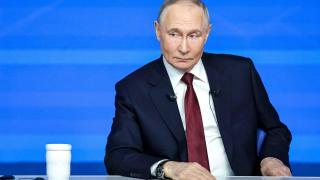

The Russian president, Vladimir Putin is “ready for dialogue” with his French counterpart, Emmanuel Macron to seek a negotiated solution to the war in Ukraine, according to Kremlin spokesman Dmitri Peskov, a proposal that has been well received in Paris.
Macron has given the “welcome” to the proposal and has said that it will study it in the coming days to find “the best way to proceed.”
“It is welcome that the Kremlin has given its public approval to this initiative. In the coming days we will decide what is the best way to proceed“, detailed in a statement the Elysée Palace.
On Friday, the French president acknowledged that “it would be useful to speak again with his Russian counterpart”, and he has considered being “ready for dialogue”, according to Kremlin spokesman Dimitri Peskov.
The last time the two leaders spoke was in a more than two-hour conference on July 1 of this yearthis occasion coinciding with the first time they met again since that face-to-face meeting they had, the February 7, 2022in the prelude to the war in Ukraine.
The Elysée stressed that the objective of Paris “will continue to be to contribute to a solid and lasting peace for Ukraine and Europe“, and that he will do so “with total transparency” with the Ukrainian president, Volodymyr Zelensky, and with the rest of the European partners.
In its message, the French Presidency recalled that they have always defended a “dialogue of demands” with Moscow and that the only time Putin and Zelensky have met was precisely in Paris, in December 2019.
“At that time, we had adopted a precise roadmap to implement the Minsk agreements. The invasion of Ukraine and President Putin’s obstinacy ended any possibility of dialogue,” the message states.
“Now that the prospect of a ceasefire and peace negotiation – the statement adds – it is once again useful to talk to Putin. “That’s what the president said this week in Brussels.”
Specifically, Macron expressed that the leaders of the EU and Ukraine They should engage in direct dialogue with the Russian president in the event of a lack of progress in the negotiations led by the United States.
“As Europeans, we have to find in the coming weeks a framework that allows us to engage in discussions with Russia, in an appropriate way and with full transparency with Ukraine,” Macron said, when asked about the issue at a press conference at the end of the EU leaders’ summit in Brussels this week.
In any case, he considered that European leaders “should not let the talks be carried out solely by intermediaries.”
In recent months
During the last video conference, it was Emmanuel Macron who took center stage, reiterating his support for “territorial integrity” of Ukraine and calling for “a ceasefire as soon as possible”.
For his part, Vladimir Putin remained in a more reserved profile for the first hour, limiting himself almost exclusively to listening. Subsequently, he stressed that any hypothetical peace agreement must be “long-term” and recalled that the current conflict “is a direct consequence of the policy of Western countries.”
In recent months, both leaders have maintained a constant exchange —whether direct or through public statements—marked by criticism. Macron has repeatedly stressed “the Russian threat”, while French military chiefs warn of the possibility of Moscow preparing for a larger-scale confrontation with Europe before 2030.
From the Kremlin, Putin has even compared the French president to Napoleon for his push for “the growing militarization of Europe.”
The next face to face between Macron and Putin will be conditioned by the recent agreement of the heads of state and government of the EU to grant Ukraine a loan of 90 billion euros.
In addition, the decision to postpone the use of the 210,000 million euros of “frozen” Russian assetsas well as the proposal to open a four-way dialogue—with the United States, Russia, Ukraine and European countries—in the current peace talks taking place in Miami.