
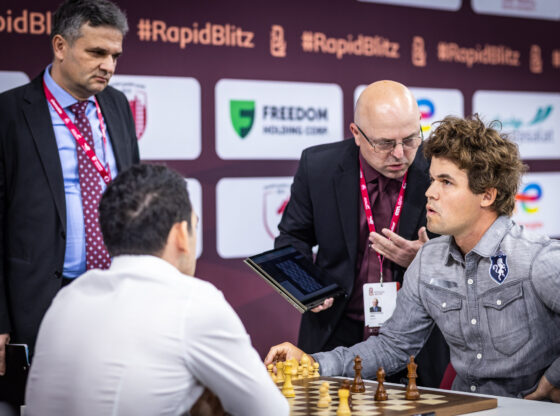

In chess, the referee is usually a figurehead. In most games, their presence is not even necessary. When they have to intervene, however, it is often because something serious has happened. In Doha (Qatar), the American Chris Bird he gave a lost game to Magnus Carlsen in a decisive round of the Blitz Chess World Cup. The reason was that the Norwegian grandmaster had accidentally thrown the pieces across the board with only four seconds left on the clock.
In this game mode (blitzin English), each player has three minutes for the entire game, plus a two-second increment each time they make a move. It is very common for the two chess players to end up making their moves at full speed. In those cases, nerves and lack of time combine and pieces can fly around the board.
In Doha, the world number one tried to rebuild the position, which he had just destroyed in a clumsy gesture. Meanwhile, he pressed the clock to stop it, in desperation, which is already considered an illegal move, because the pieces were not yet in place. His rival, the Armenian Haik Martirosyanstopped the clock and waited for the arrival of the referee, who spoke with Carlsen for a few minutes. After a brief verbal struggle, the Norwegian decided to surrender without arguing further, despite his obvious gestures of disagreement.
New stumble on the same stone
It seemed that Bird was going to apply the usual sanction, which consists of giving his rival a minute, but the American considered that the disaster had been too great. In the broadcast, it could be seen that the earthquake had lasted more than four seconds, so he ran out of time and did not deserve to continue the game, especially since Magnus had not even reconstructed the position well.
The most incredible thing about the case is that Carlsen had lost another game the previous day, when his queen fell to the ground. The piece rolled, out of reach. He didn’t have time to recover it and Arjun Erigaisi met with a relatively unexpected victory. It is true that the Indian grandmaster was better throughout the game (hence Magnus’ need to think more), but when the incident occurred a draw seemed the most likely outcome.
In that game, many commentators said that number one should have pressed the clock as if he had made his move, even though he was later punished for committing an illegality. He tried to stop it, as is done every time a player makes a complaint to the referee, but to do so he had to hit a smaller button and he couldn’t do it in those moments of tension.
Protest from another grandmaster
After his defeat, he slammed his fist on the table (it was not the first time), angry with himself. The American Levon Aronianof Armenian origin, complained in X about what happened. Bird had apologized for the gesture and assured that the Norwegian immediately apologized. «Chris, I don’t think we should normalize tantrums like that. It affects players who are in the middle of a game and hear loud noises. In many sports, acts like this are penalized as unsportsmanlike behavior to send a message to younger athletes. It is possible that this informal protest affected the referee in some way when he decided to punish Carlsen or he may have acted the same.
In this context, it is almost an anecdote that in another subsequent game Carlsen arrived late, a more frequent error in his repertoire. It was only about 15 seconds, but at this point in the tournament it was clear that every tenth can be decisive in blitz games. The Chinese Bu Xiangzhi He took advantage of the circumstance and was better, but ended up losing. Victory was key for Carlsen, who tried to win all his games, which he was almost forced to do in order to qualify among the best four and advance to the semifinals.
In another game of the same championship, Magnus lost against Fabiano Caruana, number three in the world, for leaving a rook hanging, an inappropriate beginner’s mistake for someone who is considered the best chess player of all time. And yet, Carlsen is Carlsen and almost nothing is out of his reach.
Bird chats with Carlsen after the controversial episode against Martirosyan.
In fact, all of the above did not have the slightest importance when it came down to it. Magnus came back and qualified for the semi-finals, where he beat Fabiano Caruana, a regular customer. In the final, he started with a defeat, but then won two games, in the remaining three, demonstrating that his nervous system in decisive moments is the most reliable on the planet.
His victim was the Uzbek Nordibek Abdusattorov, a great player who plays him without complexes. But it is one thing to try face to face with the number one in history and another to take away the titles. Magnus’ streak continues unstoppable. There are already 20 world championships. For now, he has given up on winning more in classical chess, but in the rest of the modalities and rhythms of the game he has no one who comes close to him.