

At the end of the last century, football had colonized almost the entire earth, but what was missing was not negligible: India, China and the United States. In the last country there was a man called Henry Kissingerfirst Secretary of Defense and then of State, who dedicated the time left free by his task of making peace in the East and stirring up coups in Latin America to preaching football among his people. He even managed to organize the 1994 World Cup for the USA, rowing upriver against skeptics at home and abroad.
Kissinger was born in Fürth, Bavaria, in 1923, the son of a Jewish schoolteacher and a housewife. The growth of Nazism led the family to make the wise decision to emigrate to the United States when he was 15 years old. New world, new life. But his childhood and pre-adolescence in the Old World had already made him fall in love with football, which he defined as “a complexity disguised as simplicity.” When he reached the highest positions in the republican administration, his collaborators had, among other tasks, to supply him with envelopes with clippings from European football, soccer in his new country, which uses the word football to designate that variant of rugby, dressed up with helmets and armours.
At the end of the 70s, he was among the promoters of the North American Soccer League (NASL), that somewhat false attempt to put soccer at the top, with a super championship whose flag was a decline but still valid. Skinwhich they would join Beckenbauer, Cruyff, Eusebio and other flashy names. That only lasted until 1984, and let’s say that if it didn’t take off there as a spectacle, it did leave a stimulus for its practice. Colleges and universities became interested in this sport, which they saw as European values, and practicing it became a distinctive sign of young people from distinguished classes. From there derived the excellent development of women’s football, which has been at the forefront of the world for years.
The ‘learning’ of 1986
Kissinger had tried to win the 1986 World Cup, which Colombia renounced after having been awarded it. The cause was that FIFA came forward with unprecedented demands that exponentially raised the cost: 12 stadiums with 40,000 spectators for the first phase, plus four with 60,000 for the second, plus two with 80,000 for the opening match and the final, plus a communication tower in Bogotá, plus freezing of hotel rates for FIFA members since January 1, 1986, plus a decree of free circulation of international currencies throughout the country, plus a fleet of limousines for FIFA executives, plus a train network between venues, plus an airport with capacity for the most modern jets in all venues, more express road network to connect the venues to each other.
Faced with such impositions, Colombia resigned, but not without great national controversy. Kissinger encouraged the United States to propose, and it did, along with Canada, Brazil and Mexico, which would ultimately take it. Mexico had a great godfather, Guillermo Cañedovice president of Televisa and FIFA, who in Colombia was always maligned that he was the creator of that list of demands. Kissinger would later declare in this regard: “The entanglements and conspiracies over the 1986 World Cup made me nostalgic for the peace talks in the Middle East.” He compensated by publishing a shocking article after the championship entitled Football and attitudeswhere he pointed out that each country plays football how it lives and how it makes war.
But he learned to handle himself in FIFA, and in 1994 he did succeed, ahead of Morocco and Brazil. To the president of FIFA, Joao Havelangean accomplice in those years of Juan Antonio Samaranch y Primo Nebiolo (world president of athletics) in the cause of obtaining large sponsorships for the sport, a World Cup in the United States seemed appropriate. The criticism in Europe and South America was devastating, and it cannot be said that the United States received the news with enthusiasm. The Washington Post wrote in his editorial: “Soccer is a game that we Americans teach our children until they are old enough to do something interesting.” And also: “Here is the sport of the future and always will be.”
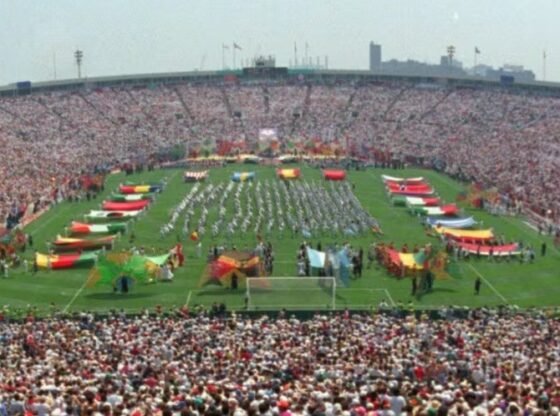
Soldier Field in Chicago, during the opening ceremony.
Kissinger reserved the role of vice president of the organizing committee, although in truth he managed everything. The US already went to the previous World Cup, Italy-1990, but lost all three games. Now that she was officially classified, she needed a competitive team to avoid making a fool of herself and Kissinger, advised by his idol Beckenbauer, chose the Yugoslavian as his coach. Bora Milutinovican archetype of globetrotter of those that football provides; He had been as a footballer and would also be as a coach. In Mexico-1986 he coached the local team and in Italy-1990, that of Costa Rica, which he previously qualified for. It was a good choice. He worked hard, with a long concentration in Mission Viejo (California) through which many players passed until he refined the final group, among whose survivors the Betic player was included. Tab Ramos. If until then the United States had played 80 games in its entire history, now it was going to play 89 before the World Cup, which included the CONCACAF tournament, the Copa América and an International tournament in Riyadh with Arabia and the Ivory Coast. The rest was a cloud of well-programmed and graduated friendlies.
24 teams attended, half as many as this coming summer, divided into six groups of four; The first two and the four best third parties went to the second round, with the novelty that the victory gave three points, not two, as it had been until then. The players wore the name on their backs above the number, a long-standing custom in American sports and already adopted by the Premier League. It was played in eight cities, on American football fields, generally old. A contrast with Italy-1990, where almost all of them were built or renovated.
The first impression was devastating: on June 17 they opened a place at Soldier Field in Chicago, Germany, as the current champion, and Bolivia, trained by our recently deceased Xabier Azkargorta, The Mustacheat the same time that police cars were chasing the driver on the highways OJ Simpsonfamous American football player (he had even participated in the successful Land as you can), alleged guilty of murdering his wife and her lover. Football lost interest, even Chicago spectators left their seats to follow the cinematic chase, filmed from a helicopter, on the televisions in the galleries. That first day the World Cup felt like someone else’s home.
86,016 spectators in San Francisco
And yet, everything grew as it went along. One cause was the immensity of that country, where people can leave from anywhere for anything. And then, the unexpected good performance of the home team, well harmonized by Milutinovic. The defender became very popular Alexi Lalasand hippy redhead with curly hair and a goatee, who evoked Buffalo Bill, but the doorman also caught the attention Meolathe libero Reynathe cerebral Wynalda and the attacking troublemaker Coby Jones. They began by tying with Switzerland and made a splash by beating Colombia in the second game, 2-1, with that own goal by Escobar that would cost him his life after a few weeks. They closed the group losing 1-0 to Romania, but that gave them the chance to make it through the crossroads and face Brazil in the round of 16.
That day soccer made a big splash in the United States. 1,500 journalists were accredited. The day before, the president Bill Clinton He personally called Milutinovic to wish him luck, and the game attracted 86,016 spectators at the Stanford in San Francisco, 2,000 more than the 1985 Super Bowl, a record to date. Brazil won 1-0, goal Bebetobut it can be said that that was a prestigious defeat. ABC broke its audience record. Milutinovic’s boys had delivered, achieving what the NASL had tried unsuccessfully with its peeled, Beckenbauers, cruyffs, eusebios and so on.
Otherwise, that World Cup left interesting things to remember: Franco Baresi He injured his meniscus in the first game. Given his age, 34 years old, we considered him retired. But it turned out that the then very modern arthroscopy technique allowed him to reappear in the final, where he was going to miss the first penalty of the round.

Salenko, during his historic match against Cameroon.
Russia participated for the first time as such, once the USSR was dissolved. One of his players, Oleg Salenkoscored five goals in a game, something that no one did before and would not do after, that summer he was moving from Logroñés to Valencia, and later he would play for Córdoba. Russia beat Cameroon 6-1, with the goal Songo’owho would later go through Depor, as a victim. But that victory did not qualify them. Salenko won the Golden Boot with six goals, the same as Hristo Stoichkovalthough achieved in fewer minutes.
Maradona He lived the definitive drama of his suspension for doping, after having overcome his addiction to cocaine with tremendous effort. The mistake of one of his collaborators when replacing an exhausted medication with another very similar one, but containing ephedrine, sank his career and his life forever.
Roger Millawho had astonished in Italy-1990 with his incorporation to Cameroon by order of the president when he was already retired, returned to this World Cup, now at 42 years old. In the five-goal match, Salenko scored the only one of his own, becoming the oldest scorer in World Cup history.
Nosebleed
Spain came with the controversial Javier Clemente as a coach and had a good championship. His team, granite, loaded with central defenders, reached the quarterfinals, where they lost against Italy by a goal of Roberto Baggio. Very soon after the end, Mauro Tassotti caused a severe nosebleed Luis Enrique with an elbow in the area that neither the referee nor the lineman saw. Who knows if with that penalty…
The final was Brazil-Italy. It ended 0-0 after extra time and for the first time the title was decided in a penalty shootout. Brazil won, with a final failure by Baggio, Italy’s star.
In general terms, that World Cup was an unexpected success. Faced with initial skepticism, the US attracted 3,587,538 spectators in the 52 games, with an average of 68,991, an absolute record. That was the most pleasant of surprises. Football had entered the country, much to Kissinger’s happiness. Since then, it has qualified for all editions, except for Russia-2018 (previously it had missed all those held between Brazil-1950 and Italy-1990) and has won the Gold Cup (which pits the Central and North American countries against each other) six times.
Now, American capital is attacking the big clubs in the Champions League and the country is preparing to organize a new World Cup, supported by Canada and Mexico. Only Kissinger is no longer in charge, but Trump…