

Starting next January 1, the German authorities will progressively contact 700,000 young Germans born in 2008 and later years to carry out a medical record and complete a form informing of their willingness to perform military service.
The idea is to get a portion of those young people to say—voluntarily—”yes” and then begin training them in batches of 5,000 a year. In the event that there are not enough volunteers, the measure contemplates the possibility of reestablishing a type of compulsory military service in the country.
Europe’s main economy is thus driving a debate that is increasingly present – and sometimes also heated – in places like Belgium, Romania, Poland, Bulgaria, France… and even Portugal. Mili yes or mili no? Among the European countries that already have it are the last two accessions to NATO: Sweden, which abolished it in 2010 only to reinstate it in 2017, and Finland, where it has never occurred to them to eliminate it.
A model inspired by Sweden
The announcement issued from Berlin this Thursday comes after months of negotiations between the two ruling parties: the Christian Democrats of the CDU, led by the chancellor Friedrich Merzand the social democrats of the SPD, led by Bärbel Bas y Lars Klingbeil.
As for the reason, German journalists who have had access to the agreement documents cite “the imperialist impulses of the Russia of Vladimir Putin“and the suspicion that it is considering attacking northern Europe before 2030.
“Currently there are already attacks of a hybrid nature orchestrated by Moscow,” the journalist wrote this week Peter Carstens on the pages of Frankfurter Allgemeine; one of the main newspapers in the country. “These attacks focus on damaging critical infrastructure [del flanco oriental de la OTAN] and undermining social cohesion,” the journalist added before stating that in the face of contract killings, espionage work and sabotage, it is urgent to act quickly: “Against all of this, Germany, Europe and NATO must prepare for their defense as quickly as possible.”
In short, what Germany intends is to increase its military reserve from the current 34,000 uniformed personnel to 200,000 so that, if it has to go into defensive mode, it can mobilize all those personnel in a matter of hours.
According to the agreement signed by the CDU and the SPD – whose official name is something like the Military Service Modernization Law – the idea is to attract those 5,000 annual volunteers by offering a salary of 2,600 gross euros per month and various additional financial aid.
Volunteers will also decide how long they want to serve between a minimum of 7 months and a maximum of 23 and, in principle, will receive basic training to be able to carry out rearguard duties in the event of a national emergency. That is to say: entering the program does not necessarily mean starting a long-term military career. They will be what in Germany are known as “temporary soldiers” or SaZ.
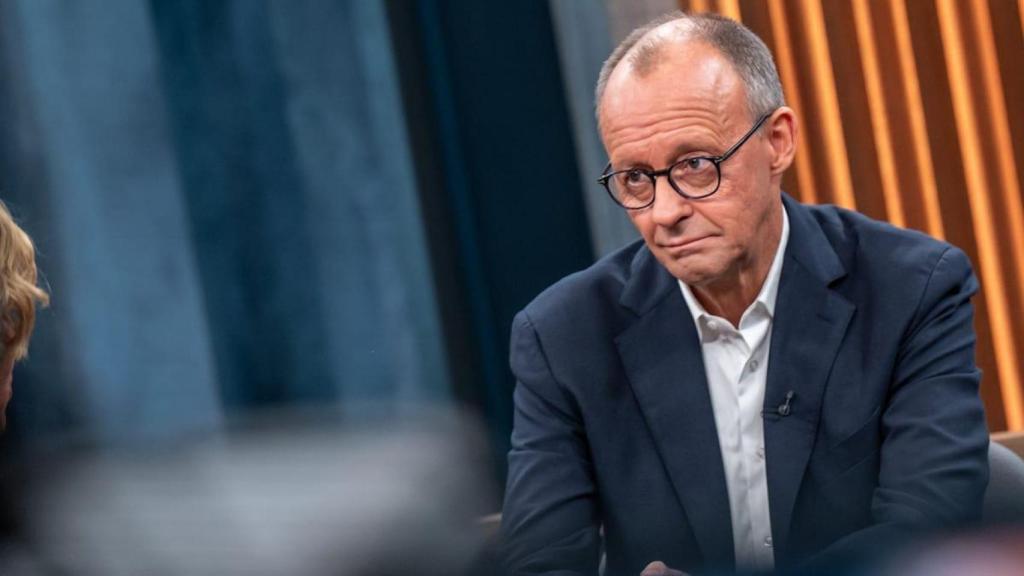
German Chancellor Friedrich Merz this Sunday during his interview.
This scheme, popularly known as “Volunteering through attractiveness”, also includes women, although they will not be required to complete the form that will begin to be sent from January 1. That is to say: in the event that there are not enough volunteers and Germany must implement compulsory military service, they are exempt. That’s why they don’t need to register if they don’t want to.
However, if the obligation – known as Compulsory Military Service due to Necessity – ends up being imposed, it will not affect all young people. According to the agreement reached by the parties in power, which by the way is inspired by the Swedish model, if the quota of volunteers is not filled there will be a forced selection based on “a random procedure” from among all the candidates considered “suitable.” With which only some will be called up, not all (in Sweden the percentage is around 10% annually).
However, the German Constitution will continue to contemplate conscientious objection and the performance of civil service in the event that the summoned person refuses to wear the uniform.
Belgium
The decision adopted by Berlin comes days after the Belgian authorities began sending letters to the country’s youth inviting them to try a military career in 2026. Or, failing that, inviting people to sign up for a year-long voluntary military service.
In the letter, sent to some 150,000 young people (men and women) aged 17, young people are urged to take advantage of a “unique opportunity” through which to learn values such as discipline and teamwork. The letter also clarifies that those recruits selected starting next year will receive a salary of 2,000 euros net per month during their service.
According to the newspaper The Free in spring and remembered The Country A few days ago, the Belgian Ministry of Defense currently manages to recruit about 2,800 soldiers a year. A figure that would barely be enough to maintain the current 24,600 troops, a number also insufficient for the country’s military objectives between now and the end of this decade.
Portugal, Bulgaria, Romania, Poland and France
Meanwhile in Portugal the debate around the possibility of reinstating compulsory military service – abolished in 2004 – has been gaining strength since the Russian invasion of Ukraine.
Its defenders argue that beyond promoting civility and social cohesion, the measure will better prepare society in the face of any type of crisis. Its detractors, on the other hand, point out the high logistical costs, the impact on individual freedom and the need to modernize the country’s armed forces with highly qualified professionals instead of mass recruitment.
For its part, Bulgaria, one of the most militarized states of the former Eastern Bloc and which has had a professional army since it abolished compulsory military service in 2008, faces a personnel deficit of 22%. Given the delay in recruitment despite recent salary increases, the Minister of Defense, Atanas Zapryanovhas stated that limited mandatory training is being considered, especially for firearms-related positions.
In Romania, meanwhile, the population has been reminded several times since the Russian invasion of Ukraine that despite not having compulsory military service since January 2007 – coinciding with its accession to NATO and the European Union – national legislation contemplates its reactivation in the event of war.
For its part, Poland, which already has military training programs for civilians who wish to do so, announced at the beginning of this year its intention to reinstate some type of military service. Although the country’s prime minister, Donald Tuskdid not offer much more details, but did say that the idea is to reach 100,000 annual participants so that later, in the event of conflict, a good part of the population can be mobilized immediately.
And in France there is also debate. The neighboring country suspended military service in 1997, during the presidency of Jacques Chiracbut the matter has returned to the public sphere thanks to the current president: Emmanuel Macron.
In the French case, the reinstatement of compulsory military service (for men and women) would mean an annual expenditure of 15 billion euros, according to a report by the French High Commissioner for Strategy and Planning. A relevant fact, say experts in French politics, taking into account the serious political crisis in which the country is immersed.
“Once considered a matter of the past, military service has once again occupied an increasingly relevant place on European political agendas since the Russian invasion of Ukraine in 2022,” read a document issued by the European Parliament at the end of August.
“The growing threats to European security, fears of a transatlantic disengagement, as well as the position of the new US administration and possible peace plans for Ukraine that involve the presence of European troops” were, according to the aforementioned document, the main factors behind this hypothetical military ‘renaissance’.
“Awareness has increased about the need to prepare the armed forces of the Member States for the most extreme military contingencies,” he stated.