

In the 70s, authoritative voices began to appear announcing: “When black Africa wakes up, it will reign in football.” The forecast was based on the immense physical potential of the people from that part of the world, with strength, agility and speed very good for this sport. We had already had some examples in Europe, the most important being Eusebio, born in Mozambique when it was still a Portuguese overseas province. From the same time it was Kialundaa Congolese who triumphed at Anderlecht. Here they impacted Salif Keita and the gambian Biri-Biriwho arrived at Valencia and Sevilla in the 1973-74 campaign. And the black race was already very present in South American countries with a long football tradition, and it was clearly noticeable. Particularly in Brazil, with Skin.
Football took longer to enter sub-Saharan Africa than in the Maghreb, and when it arrived, the conditions of poverty did not allow the existence of good fields. In general, they played anarchic football, with no purpose other than entertainment. But, it was said, it was a matter of time before they had fields, tradition and a tactical culture little by little implanted by European technicians who were beginning to go there.
The first team from that area to participate in a World Cup was Zaire, in the 1974 World Cup in Germany, which won the only African place. (Morocco went to Mexico ’70, Tunisia would go to Argentina ’78). It was a disaster. They lost 2-0 with Scotland, 9-0 with Yugoslavia and 3-0 with Brazil, leaving a folkloric image of witches, fetishes and threats from their president, Mobutu Sese Seko. Another thing would be Cameroon, already in Spain’82, where with the expansion from 16 to 24 teams, Africa now had two and Algeria and Cameroon came. Algeria did not pass in its group by a ton between Germany and Austria. Cameroon scored the same points as Italy for second place and was eliminated by goal average, but left a good impression, especially the forward Roger Milla. They tied with Poland, semi-finalists, and with Italy, champions.
President Biya’s order
In Mexico ’86 the two places would be for Algeria and Morocco. Cameroon was going to return, along with Morocco, in Italia’90. And it would ring the bell. The coach was Valery Nepomnyashchyformer Soviet footballer, retired at the age of 25 due to a kidney injury. He signed in 1988 as part of a collaboration program between the two countries. He arrived for the under-21 team, but the coach left and the position fell to him. He signed for two years, with the horizon of Italia’90 and qualified them, winning the group against Nigeria, Angola and Gabon, and then eliminating Tunisia.
The local league amateurwas suspended to prepare for the World Cup. Nepomnyashchy made a list of 40 for a first screening and one day he got four, another 10, another six… And not always the same ones. They were not given permission to work. The day he was able to put on a little game he considered it a success. Finally he chose 28 for the final concentration, in a military camp near Split, then Yugoslavia, today Croatia. There they were joined by the 10 European professionals, eight who played in France, one in Switzerland and our N’Konogoal of Espanyol, who played in the Second Division that year. The parakeets They finished third, which gave them access to a promotion against Málaga, which N’Kono would miss out on. The goalkeeper heard on the radio his team’s return to Primera with a penalty shootout in Malaga.
That’s when the president’s order came, Paul Biyato incorporate Roger Milla, two-time African Ballon d’Or winner. At 38 years old, he was retired. After a career that began at the age of 14 in Cameroon and culminated in France (he won a Cup with Monaco and the African Cups in 1984 and 1988), he said goodbye with a double tribute in Yaoundé and Douala, the only two stadiums in the country. Now he played for pleasure for Saint-Pierroise, on Reunion Island.
Vautrot expels Massing after a tough entry on Cannigia.
They waited for him uncomfortably, but his behavior pleased them. He didn’t act important, he gave good advice, he trained thoroughly and accepted the role of substitute. The work was terrible, like the Soviet army, climbing hills with a partner on top over and over again. There were abandonments and the friendlies were not reassuring, as they lost all of them except the last one, against the Yugoslav U-21. With that background and the perspective of opening the opening day, against the champions, Argentina Maradonathe 22 survivors were flown to Milan.
When Nepomnyashchy gives the lineup at the hotel, five hours before the game, there is a surprise: he does not play Bellfrom Bordeaux, who was considered the starter, but N’Kono. The reason was that the group had been given 800 dollars to distribute among everyone for qualifying, Bell learned that other teams were charging up to a million and a half, he raised that hare and the Minister of Sports demanded that the coach remove him. N’Kono wanted to resist, but Nepomnyashchy told him: “If you don’t play, I’ll put a forward.” And he played. One more factor of nervousness when they line up in the center of the field in front of a packed San Siro, of dimensions unknown to almost everyone. President Biya, another threat, is attending, and they cannot expect more support than that of a small group of relatives of those who played in Europe.
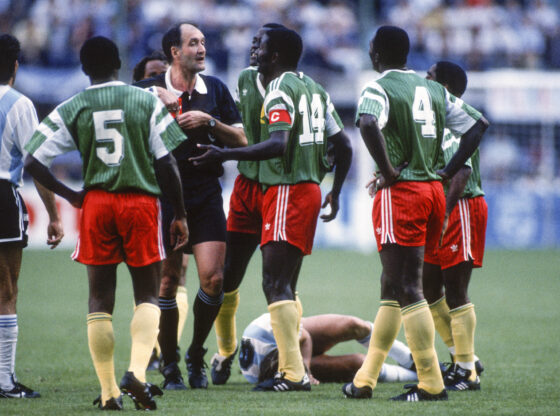
The captains, clear and Maradona, dodge the fields, and the Argentine retreats doing some intimidating juggling with the ball. That makes them angry. And they are even more angry that the abundant Argentine group makes monkey noises at them. Singing their anthem has strengthened them and they come out determined to sell their black skin dearly. They run, jump, charge and hit, run, jump, run and hit… The super hard Massing He warns Maradona: “I’m an amateur with nothing to lose, if you come here I’ll take you away.” Maradona does not wrinkle, he will suffer up to 12 fouls, 10 of them punished with a yellow card by Vautrot, which means that everyone hit him. In the second half Caniggia comes out to share the blows with him. But for a while Cameroon no longer just hits. In the 20th minute, M’Fedé, who looks like Milla, dribbles past two Argentinians, delivers well and creates a scoring chance. The team discovers that they can play. As Argentina swims and puts away its clothes, the match is balanced. In the 68th minute, Omam-Biyik He hangs from the sky and headbutts the one who Pumpido it fails dismally. Argentina goes on the attack, Vautrot makes things easier for them in the 72nd minute, with the somewhat rigorous expulsion of Kana-Biyikbrother of the scorer. Argentina overturns, but does not penetrate and its shots into the pot are dominated by N’Kono. In the 90th there is a second expulsion, Massing, which turns Caniggia. In stoppage time, new Argentine efforts, some counterattacks with the air of a goal and the final whistle with Cameroon’s victory. A bomb, David against Goliath again. Buffonthen a boy, decided that day, inspired by N’Kono, to go from being a field player to goalkeeping.
The All Africa Team
Then it’s Romania, before which they apply to Hagi the same treatment as Maradona. Less brave, he retired in the 56th minute. In the 61st minute, Nepomnyashchy brought out Milla, absent against Argentina, and his emergence fascinated: he scored in the 76th minute, repeated in the 86th minute. The final goal of Balint it’s useless. In two games, Cameroon has secured first place in the group. The following days are difficult for the coach, concentration is disturbed by reports, gifts and agents with their offers. He still has to play against Russia and the plan is to give massive breaks, but the Sports Minister tells him that it would be frowned upon, since he is Russian, and demands that he put in the best players. He does so and the result is a 4-0 defeat.
The suit comes in handy, it makes everyone reflect and they decide to face the round of 16 with maximum concentration. The rival is Colombia Higuita, Valderrama y Redinahead of that. His game is a pure touch that beats the Cameroonian gale. Milla comes on at 59 for M’Fedé, the game ends 0-0, but in extra time she rubs the lamp again and scores at 106 and 109, the second stealing the ball from Higuita on an excursion to midfield. Once again the rival’s late goal is in vain. Cameroon advances to the quarterfinals, where no African team has ever reached before. It is already the stunner of the World Cup, the team from all of Africa. Cameroon is living a delirium. Since the second match, the many cities without electricity have emptied on match days because their people go to Yaoundé or Douala, to watch television where they can, sleep in the house of a relative or countryman, or on the street, and return the next day. There is a national exaltation.
The quarterfinal rival is England. BeckenbauerGermany coach, says he would prefer to meet England in the semi-finals rather than the Africans. At that point the question was: who can stop Cameroon?

Omam-Biyik, during the quarterfinal match against Colombia.
England tries to intimidate by first occupying the tunnel, with shouts and chants, but they are the ones who are intimidated when the Cameroonians come out of the locker room, singing a song between warrior and religious, while tapping their heels on the ground with that very African rhythm. Then they play better than ever, they attack with faith and ingenuity, they make quick and precise plays. It’s impressive. Still scores ahead Plattwith a good header. Milla appears in 46, again as a shock. In the 63rd minute they gave him a penalty that transformed Kundein the 65th minute he passed a pass to It belongs to the plowswhich marks 2-1. Cameroon is confident, enjoying itself, and is giving its recital when, due to a mistake, England arrives and a debatable penalty causes the score to be 2-2. Lineker. In extra time, another penalty also converted by Lineker ends the beautiful story. Cameroon is out and the millions of supporters it had won around the world, myself included, are disappointed. They say goodbye with an Olympic lap, highly acclaimed. They have entered everyone’s hearts. For once, black Africa is no longer seen only as a place of wars, epidemics and hungry children.
The 747 that is going to pick them up from Rome has to circle around Yaoundé twice until the Police manage to clear the runway of the crowds that are gathering. The whole country is in the streets. The president awards them with the order of Knight of the National Order of Valor and promises them each an apartment. The apartment took 30 years to arrive. Too late for Massing, M’Fedé and Captain Tataw, who died because he could not afford treatment. Paul Biya remains president after half a century in office. A large brewery called Nepo in honor of Neponmaneshchy was opened in Yaoundé, but was not renovated. He became a globetrotter on the bench.
Roger Milla signed for Tonnerre in Yaoundé and retired at Pelita Jaya in Indonesia. He still played in USA’94 and scored a goal at the age of 42, a World Cup record. He is now a UNICEF ambassador. For USA’94, the quota of African teams was already expanded to three, which has only increased since then. In the next one, with 48 participants, there will be nine, plus the possibility of another, through the repechage. But until Italia’90 no African team had dreamed of reaching the semi-finals. The feat of The Indomitable Lions is still very present.