
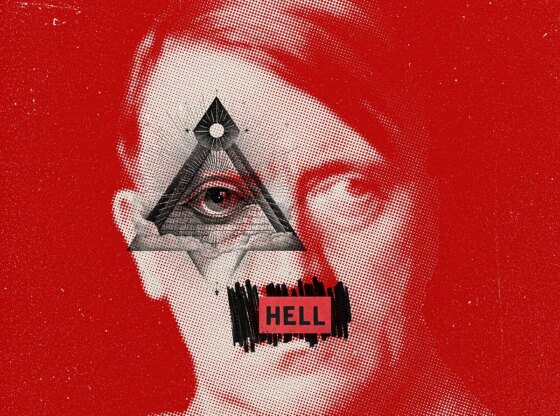

We measure degrees in Celsius, radiation in Roentgen, energy in Joules, pressure in Pascals and evil, although we do not realize it, in Hitler’s. His evil has made him an unparalleled reference point of incalculable value to the Western world. Turn on the TV, the radio, any day, at any time, and you will see that we continue to define our values with reference to Nazis and fascism. It is now impossible to shake off the fascination we feel for them and their leader.
It is announced by Alec Ryrie, a British historian specialized in Christianity, in The Hitler eraand how to survive it (Gatopardo editions). A book that, he maintains, “is not about Hitler, but about ourselves.” Because the Hitler era is not the 30s and 40s of the last century. It is our own era and, it seems, it is coming to an end.
Ryrie, as a Theology graduate from Cambridge University, says things like “Adolf Hitler has replaced Jesus as the most important moral figure in the Western world.” Or even worse: “Maybe we still believe that Jesus is good, but not with the same fervor and conviction with which we believe that Hitler is bad.” The West has redefined its moral compass following the decline of Christianity and figures like Hitler have filled the ethical void.
But above all, Ryrie is a guy fascinated by evil. You see Hitler everywhere, because Nazis dominate the modern cultural imagination, from Star Wars to Harry Potter, while the memory of the real Nazis is dangerously fading.
In the last decade, multiple groups from across the political spectrum, both in the United States and around the world, have invoked Hitler to make moral judgments on any topical issue. It doesn’t matter whether it’s feminism or a lack of water, which demonstrates Hitler’s enduring power as a hegemonic historical analogy. What’s more, depending on the day or the audience, one may have to play Hitler or someone who accuses someone else of being one. When Russia invaded Ukraine in 2022, memes of Vladimir Putin like Hitler, while Putin himself said that he was “denazifying” Ukraine. And while it stops Boris Johnson The European Union was Hitler, he was regularly depicted with a toothbrush mustache.
–But if everything is Hitler, if everything is fascist, nothing is fascist.
–This is one of the problems, that it is a symbol that we use too much, that if we label it fascist Everything becomes meaningless. The term is already empty of meaningbut it is the demonstration that when you have a symbol of absolute evil you are going to use it all the time because it is very useful, just as the ancient Christians talked about the devil all the time.
For now, we continue to define our values with reference to the Nazis. We cannot get rid of our own fascination. Although, explains Ryrie, “it is increasingly evident that the anti-Nazi story cannot achieve the full effect we ask for,” of covering the post-war ethical void. The resurgence of the far right and cancel culture show that positive morals are also necessary to strengthen society. «A culture that only has ideas about evil to avoid is an anemic culture. which, rightly, has cracked and is beginning to be left behind,” Ryrie is supported by Manfred Svensson, Ph.D. in philosophy from the University of Munich.
–But the truth is that we are going with this, at least in Spain, that it seems that it does not matter what happens in the Government or in the president’s own house as long as the others are designated as extreme right.
–Anything except fascism seems to be acceptable. We have seen it all over Europe. The most striking example of this was the 2002 French presidential election: Jean-Marie Le Pen against Chirac. All of France vindicated itself by saying that it had voted for the corrupt, and not for the fascist. It is difficult to think of another country in the democratic world where such a broad consensus can be found to reject right-wing figures in favor of any alternative. But that doesn’t work anymore.
– Is it safe?
–In fact, I think it might not take long for us to see a far-right president in France. The trick has already been tried too many times.
“A culture that only has ideas about evil to avoid is an anemic culture that has rightly cracked and is beginning to be left behind”
The Hitler era is the time when the Western victors of World War II established the foundations of global dialogue. Many of us have lived most of our lives in an era of broad and stable consensus about our most basic values: all human lives are worth the same; all human beings have fundamental and inalienable rights; our lives, bodies and consciousnesses belong to us and no one else. These truths seem obvious to the point of banality. However, most people, for most of human history, have not believed in such things. «We cannot help but despise our ancestors for having been unable to see the truths that we see, nor can we help but think that, now that we have assimilated them, we will never forget them. But this is simply false. “A demonstrable error, an incorrect assessment.”
–And yet we insist on rectifying the errors of history, and we judge the Spanish Civil War or the conquest of America with our 21st century eyes.
–As a historian I don’t like this kind of thing. We have to understand the contexts in which the events occurred. It’s not to say that it doesn’t matter, but you can judge how people at that time judged. Bartolomé de las Casas does not give us a 21st century perspective on the atrocities of the conquistadors, he gives us a 16th century one. I hope that in 100 years whoever talks about the 21st century will treat us with a little more generosity.
Ryrie believes that the rest of the planet has grown tired of being subject to Europe’s historical traumas. Come on, the discourse that the others are the extreme right is not worth it if you want to win elections on the Asian continent. «A few weeks ago someone was telling us about a trip to Taiwan for an international conference in which They placed the flags of the participating countries, and of Germany they placed a Nazi one, with swastika and everything“, account. “Of course, the European guests were scared, but they didn’t know they had done something so offensive. These things matter a lot to us and for good reason, but in the rest of the world the game is played differently. Also, as we progress, these events begin to feel like ancient history. My children, who are teenagers, are very aware of this history, they live with a historian, but they see it as something very old.
French writer Renaud Camus, known as the creator of the far-right Great Replacement conspiracy theory, has lamented what he calls “Adolf Hitler’s second career,” referring to this career of the Führer as a moral symbol. Camus and other activists point out how the specter of Nazism is invoked when they propose mass expulsions of immigrants, purges of the judiciary or restrictions on the religious freedoms of Muslims. It’s time, these people believe, that we stop fearing ghosts with swastikas.
“If you have a symbol of absolute evil you are going to use it all the time like the ancient Christians spoke of the devil”
–It seems that young people today are not afraid of swastikas either.
–Evil is always fascinating. When you give this regime the status of the worst that ever existed, and Hitler the status of the worst person in the world, it’s already interesting. People want to know more. But Defining our values by choosing a person as a symbol of evil is not a good idea.
–I don’t know if due to lack of historical knowledge or due to lack of solutions in democratic systems.
–For your generation and mine it is a very simple choice. There are two options: either there is democracy or there is authoritarian government. And if democracy doesn’t work very well, we still know that of the two options, democracy is the best. But For a younger generation, who have grown up in a world where democracy is the only option, and does not work brilliantly, it is reasonable that they start thinking about alternatives. And what our generation has to tell you is, of course, explore other alternatives, but we know of some that could go wrong because they have gone wrong in the past. The mistake our generation can make is to say we are going to keep this system and not allow any changes because we are afraid of where it could lead us.
Western cultures are in the process of bifurcating into two great value systems, antagonistic, mutually exclusive and almost mutually incomprehensible for which Ryrie has a definition and a message: “If you are a progressive, secular-minded person, who enthusiastically embraces our anti-Nazi values, I want to tell you this: take a little distance and admit that your cause is precarious.” For progressives, progress has stopped meaning authentic progress, and “has begun to mean the return to a comfortable and half-imaginary consensus.” «The future seems more abominable than hopeful. Because in the meantime, populists multiply and the planet warms. “I don’t know what you’re doing but it’s not working,” Ryrie tells them. «The world is full of people who think differently. Pretending they don’t exist or dismissing them as unacceptable is either not ethically defensible or simply not working in practice.
Hopefully, Ryrie points out, progressivism will stop being convinced that its duty is to carry the weight of the worldand they will begin to believe that they are just people, with things to be proud of and ashamed of, like any neighbor’s son. “We have left Western identity in the hands of trolls who use it as a weapon, evoking the worst of our recent history.”
But Ryrie also sends a message to conservatives. “The self-styled progressivism of the anti-Nazi era and its infuriating moral arrogance may make you suspicious or irritate you.” Furthermore, Ryrie explains, “Not only is provoking the opposition fun (given how seriously they take themselves and how easy it is to provoke them), but each meme is one more puncture in the cultural bubble that progressivism has created around it.».
People raised in anti-Nazi myth have been taught to look for comic book villains who openly challenge their values. After decades of reluctantly fighting diffuse and complex evils, they suddenly enter the scene a Trump or a Bolsonaro who seem determined to make all their fantasies of evil come true. «The fact that liberals know that they are being manipulated does not prevent them from attacking these characters with something resembling gratitude. They may not know how to deal with climate change, the stagnation of the economy, or the squabbles within their own coalitions, but a Dark Lord, even if it is a Dark Lord dressed as a clown… this they understand. Against this they can mobilize and, despite how unpopular many of the things they defend are, become strong and sometimes even win.
But despite so many battles throughout history, both physical and cultural, against a real or imagined enemy, the only battle, and the greatest of all, Ryrie concludes, is still fought against ourselves.