

To reach the study what Juan Miguel Quiñones (Cádiz, 1979) has in Estepona you have to get on his pick uphold on to the door handrails and trust that the vehicle does not deviate from the narrow dirt road that curves as it goes up and down the mountain range that guards this Malaga city. When the roofs of one of the most touristic areas of the Costa del Sol disappear, in a valley where all there is are piles of copper earth and vegetation, a gray gate appears, surrounded by a block wall of the same color. Without houses for several meters around, without a single sound beyond the wind and, of course, without mobile reception.
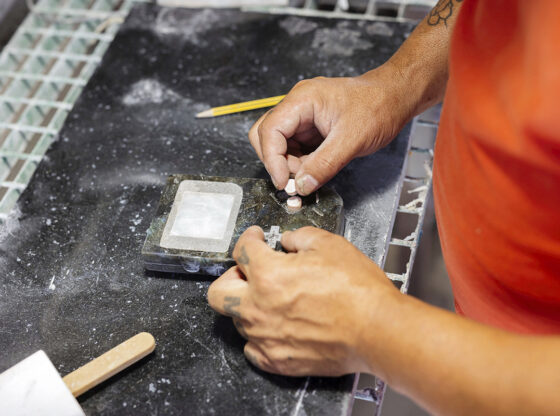
“Wait, I’m going to hold the dog before you come in,” says this unusual sculptor from Cádiz, who has been living in Estepona since his childhood, where his father came with his family to build tourist complexes. He smiles while his gallerist, Flor Reiners, founder of Reiners Contemporary Art in Marbella, and the gallery’s director, Pierina Seinfeld, are still recovering from the trip. When the gate is moved to one side, there is no longer a dog, but Quiñones’s orange shirt appears and behind him a scene that is difficult to describe in all its essence. But let’s try it. To the right, a door and a wall cover his house and a room still under construction waits to receive his works. In the background, on a huge board, supported by trestles, rest sandpaper, stones, half-built pieces, a saw… Above them, on the shelves, there are dozens of boxes of detergent capsules from Ariel, wafers from Mercadona, olives from the same supermarket with small scraps of quartz, malachite, marble or lapis lazuli. Next to it, free, a countless number of those same larger stones that are mixed with chisels and rudimentary gadgets. On the opposite wall, a standing shelf, with plastic boxes like fruit boxes, full of odds and ends. There are also an old carpentry-like table saw, a portable electric sander, and three crushed fans hanging on the two walls – the only electrical thing in the space.. All covered only by a sheet of uralite that serves as the roof of this shed that has become the workshop of a sculptor who began working in construction when he left his studies, who was a restorer without any training, self-taught, and who has now been building an artistic collection that until December 14 is on display at the Centro Mirador del Carmen in Estepona.
What is inside there, under the name Quiñones: originally, there are 180 sculptures made of marble, travertine, alabaster and other precious or semi-precious stones – quartz, malachite, granite, lapis lazuli, onyx, jasper… – that have each been carved by hand by this sculptor, without the help of absolutely anyone. And there is also the very concept of the architecture of pleasure that Henri Lefebvre and his Spanish disciple Mario Gaviria developed in the 70s to define the tension between the desire for enjoyment and the commodification of the territory that was experienced in summer resorts like Estepona. «What I want is to transport you to your childhood. To those moments of the summer of childhood where work didn’t matter, nor studies mattered, nor anything else but enjoying and being free. A child is free because he has no pressures about money, a partner, anything. I want my work to take you to that, to be naked on the beach», points out the sculptor, who has the words art and love tattooed on his knuckles, leaning on his own Dracula, that ice cream that Frigo launched in the late 70s with a vanilla interior and strawberry syrup covered in a cola-flavored layer, built in black marble, Triana yellow and travertine. Its height exceeds three meters, its weight reaches up to 3,500 kilos and its price is 60,000 euros, plus taxes.
That is the jewel in the crown of an exhibition in which you can see Santa Cruz brand scooters with their hardware and training wheels; a playstation of the first model that arrived in Spain, in black and with a gold cable; gameboy color in every imaginable color range; a little joke camera whose inside a clown’s face comes out when you press the button, and an infinite range of ice creams that have made up the childhood of all the children in this country – from the maxibon to the frigopie, including the colajet or the twister. «I have done all this from a selfish point. I made the skatesthe dracula and all the ice creams because it is my childhood and it is what I have enjoyed. Then it was exhibited and there are people who identify with it, but I did it for myself,” says the creator, whom a worker at the art center defines as “the Michelangelo of our time.” “I hope you put it in,” he insists. So here it is because, deep down, the comparison makes sense in itself.

All of Quiñones’ work is made with a traditional method of sculpture, just as Renaissance artists did, without using machines beyond the table saw to cut the stones and electric sandpaper to polish some of the stones in his shed. The process of creating the work is absolutely manual, following the hard stone technique, which consists of taking a marble slab, making a three or four millimeter indentation with a shape to be able to insert inlays into it. So, for example, the gameboy of this artist are composed of that marble base and the details – buttons and screen – are made with another material that is embedded.
And, now the question that hovers above, how did a boy who did not want to study, who made a living from construction, who has not received artistic training, do all this? «I don’t know, I have no way to explain it. I guess it’s something innate that comes to me on its own. I have always had a love for stones, I started little by little, I walked through the rivers looking for colored stones. What the hell was I going to think I was going to get this far?. I started making art without knowing what art was,” explains Quiñones, who remembers the first time he became fascinated by sculpture. He was a kid who had just arrived from the military, in his family’s construction company he was in charge of laying asphalt and in one of the most exclusive hotels in Marbella where he worked he came across a Hellenic sculpture. “I thought I knew how to do that, I was convinced.”
He was not wrong, although all his knowledge was reduced to the lessons about work in the quarry that he had taken from his father and the taste for stones and minerals that he had developed on his own. He knew how to do it even though no one had taught him how. In 2003, the owner of an antique shop decided to offer him a restoration job without having seen him work. He asked him to fix the hand of a statue, the most difficult part for a sculptor. He did it the first time. «I went on a Saturday when it wasn’t working, I restored it without a problem. I was already doing some of my things, but not professionally,” recalls the sculptor, who began to dedicate himself exclusively to his sculptures 12 years ago when his second son, Juan Miguel, was born. «I tried several times, but it was complicated because they always trip you up. I was a father of a family, I had a serious problem with the company and I sent my permanent job and my salary to waste, and I got into this mud. They told me I was crazy, that I had children and a mortgage, but I’m only going to live once and I had to do it.

In 2013, with the country still suffocated by the consequences of the 2008 crisis, Quiñones set up his “small studio” in the shed of his house where now, on a wooden chair full of dust, he tells this story. There he begins his day every day around five in the morning. He drinks the first coffee of the day alone, without a single noise, and starts production until he has to take his children to school. And then it continues without rest until the body says enough and the night falls. «For me this is 24 hours a day, I live for this job, it never leaves my mind. I come from working on a piece-rate job with my family, I have never seen a tutorial or given a course. Yes, I haven’t had internet until three years ago. Even though I have to spend 24 hours now, it doesn’t worry me. All the hours I spend are always few for me and I am never satisfied,” explains the artist. In fact, among the discarded works in his workshop, some barely have a small notch, almost invisible to the eye. “Either she’s perfect, or she’s not going to get out of here,” he settles the conversation.
–Why are you doing all this alone?
–I think it is a matter of pressure and because I feel more comfortable doing it myself. This concept is mine and mine alone, my vision is not to become a millionaire with this and I know that I am going to do a limited work. I am never going to send a factory to make my sculptures. When I am 70 or 80 years old and can no longer sculpt, there will be no more of my work. Is that okay? I don’t know, but I’m just saying what it is. For me, the work must always be created by the artist. And anyone who thinks otherwise seems very legitimate to me, I don’t criticize them. A lot of people beat me up for this, but it’s the fucking reality. You buy a painting, saving the distance, by my beloved Andalusian countryman Picasso and you don’t want someone else to have painted it. Because it will seem like shit to you. Well, that’s what happens to me with this.

–But the time will come when if you stop doing it, someone will copy you and will be the one who reaps the financial benefit of doing it yourself.
–There are people who already do very similar things with 3D printers, and the truth is that it is something sweet and bitter. Because that’s because I’m doing it like a motherfucker, that they notice you is the first sign. But, on the other hand, and I don’t know if you can put it, but they are sons of bitches. I can’t imagine doing this outside of here, man. I don’t see myself locked in a studio or a warehouse in Madrid, which has been offered to me. I need to go out, not hear anything. Look, listen: only the wind is heard. This is what I need every day, to wake up and be here calmly, because otherwise it is impossible for me. I already have enough problems in my head without someone coming to warm it up for me..
That the artistic is the driving force of everything the sculptor does above the economic, is explained by the fact that he is in charge of obtaining all the stones that are seen in his works – although on three occasions he avoids the question about how much it costs to buy them – and that, in the beginning, the smaller sized poles – about 60 centimeters – were sold for 100 euros. «My lack of economic ambition is what has allowed me to get here. At first I sold my works for 100 bucks because hunger is very bad.. I know that there are many people who say that their work is very important, but the work is there to sell, make another one and be able to fill the refrigerator,” concludes this man from Cádiz-Malaga.
And your pickup takes the reverse route to Estepona along the same dirt roads. The same one that they have previously made their sculptures.