
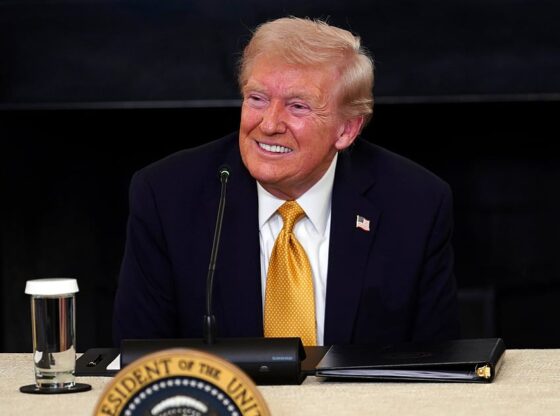

South Korea and the United States announced this Wednesday, 30, that they concluded a trade agreement that they had been negotiating for several months, following a meeting between presidents Lee Jae-myung and Donald Trump.
“We concluded a deal. We did a lot of different things,” said Trump, mentioning an “excellent session” in Gyeongju, a historic city southeast of Seoul, cited by the France-Presse news agency (AFP).
The South Korean president’s top adviser said the deal includes tariffs on automobiles and details South Korea’s investment commitments.
According to Kim Yong-beom, the agreement provides for a reduction in customs duties to 15% in reciprocal tariffs on automobiles.
It also foresees a South Korean investment plan in the United States of 350 billion dollars (300.6 billion euros, at current exchange rates), “of which 200 billion in cash”.
The remaining 150 billion dollars will be allocated “for cooperation in the shipbuilding sector”, said Kim.
“Basically, we finalized our trade agreement and discussed other issues related to national security, among others,” said Trump during a dinner with the leaders of the Asia-Pacific Economic Cooperation (APEC).
“I think we have reached a conclusion on many very important points,” he added.
Trump announced at the end of July that he agreed to reduce customs duties on South Korean products to 15%, in exchange for Seoul’s commitment to invest US$350 billion in the United States.
South Korea should also commit to purchasing 100 billion US liquefied natural gas (LNG) and other energy sources over the next three to four years.
However, surcharges on automobiles remained a point of contention and the terms of the investments were intensely discussed.
The detention of hundreds of South Korean workers by immigration police in the United States has also created tensions in relations between the two countries.
Seoul was seeking to finalize the terms of the agreement, considered crucial in particular for the South Korean automobile industry.
The North American market absorbs half of South Korea’s automobile exports, which represent 27% of the country’s total exports to the United States.
The South Korean president had also specified, in August, that 150 billion dollars of the total planned investments would be allocated to shipbuilding, with the remainder to be distributed across sectors such as semiconductors, batteries, biotechnology and energy.
South Korea, the second largest shipbuilder in the world, just behind China, has invested in this sector in negotiations with the United States, whose shipyards are having difficulty meeting domestic demand, something that Trump would like to see reinforced.
Trump is on a visit to Asia that began in Malaysia and included Japan before heading to South Korea, where he is expected to meet on Thursday with his Chinese counterpart, Xi Pinping.