
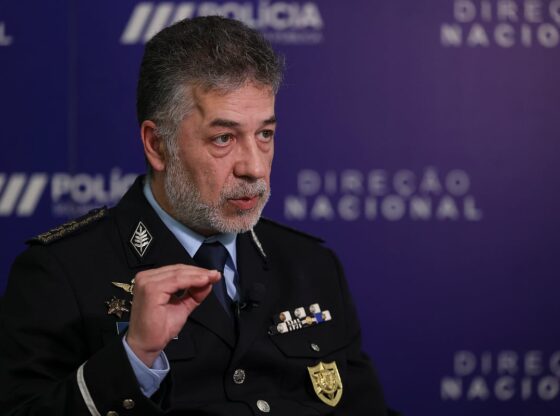

The head of the PSP’s National Foreigners and Borders Unit estimated that “large tens of thousands” of immigrants live in the country in an irregular situation and expressed concern about the recent networks detected at airports, especially involving Portuguese-speaking citizens.
“I would say that we have a large number of tens of thousands of people who are in an irregular situation in the national territory”said the deputy national director of the PSP and responsible for the National Unit for Foreigners and Borders (UNEF), João Ribeiro.
The person responsible admitted that, most of them will be simple cases, “perhaps due to inexperience, perhaps due to inaction, looking at the legal context that existed, or because they did not deliver documents, or because they should have proved certain situations and did not”.
“The point is that we now have a more coherent framework in terms of what regulated migration is,” he stated.
In an interview with the Lusa agency, João Ribeiro said that some of the immigrants had expressed interest (instrument that was extinguished in June 2024 and allowed foreign citizens who wanted to live in the country to apply for a residence permit), but others have arrived without that instrument and without having made any record.
“They never came forward with any documents. If they didn’t gather the documents when it was due, they are in an irregular situation”, he said, realizing that the immigrants who find themselves in this situation are essentially Brazilians and from the Indian subcontinent such as India, Pakistan, Bangladesh and Nepal.
Noting that this number is related to “the excessive volume of processes that AIMA had to deal with and which represents great challenges” for the PSP, João Ribeiro stressed that the new PSP unit’s “main concern” is these immigrants in an irregular situation and those who are currently entering Portugal and who represent a “great risk” for the country and the Schengen area.
In this sense, he advanced that “one of the recent concerns” of the PSP is related to the recent networks detected at airports.
“Since the expressions of interest ended, [esse tipo de redes] it is seen as a simpler way” of trying to enter the country, said the official, arguing that it is necessary to “look more closely at this approach”.
The PSP has detected many false contracts at airports, with companies that do not exist, by “citizens from different CPLP countries [Comunidade dos Países de Língua Portuguesa] who want to come to Portugal to work”, he said.
Some of them will even have “confessed that they paid to obtain these documents” and many of them may even be “using Portugal as a gateway to Europe”.
The person responsible maintained that the bet will be on being able to anticipate risk scenarios. He exemplified that there has been “meetings and contacts with the migration and border police of other countries, namely the CPLP”, in order to reinforce air borders in those States that pose a risk to Portuguese borders.
He also mentioned that in the last month several training courses were held in several CPLP countries to train local border police in detecting risky situations that represent migratory pressure towards Portugal.
“By designing these elements we are going to the origin of the migratory routes, especially because the migratory pressure that some of these countries have is not so much nationals of those States. It ends up being a whole group of neighboring States in which there are migratory routes that try to use the quality of the CPLP country to come precisely to Portugal”, he said.
Human trafficking
The person responsible for the PSP’s UNEF also said that more cases of human trafficking in Portugal for labor and sexual exploitation and ‘importation’ of children for adoption are being reported.
“Unfortunately, we have seen signs that Portugal is also a destination for trafficking in human beings for labor exploitation, whether for sexual exploitation, or also, unfortunately, some cases in which there are processes for import purposes, and I apologize for the expression being too strong, importing children for adoption”said the deputy national director of the PSP and responsible for UNEF.
Regarding the ‘importation’ of children for adoption, João Ribeiro said that the PSP is detecting situations at national airports in which “apparently family members or non-family members” arrive in the country with children and which raise suspicions. “This is one of the aspects that we have increased the capacity of airports to signal”, he also said.
In an interview with the Lusa agency, João Ribeiro explained that competence in the area of the crime of human trafficking lies with the Judiciary Police, but the Public Security Police “play a fundamental role in terms of prevention” to be able to signal situations that occur at airport border crossings and at national level.
“The situations essentially occur in large urban centers, in metropolitan areas, and also on the coast. In this sense, I must say that there is an excellent relationship with the National Republican Guard and the Judiciary Police, in identifying these situations”, he highlighted.
Célia Paulo, Lusa journalist