
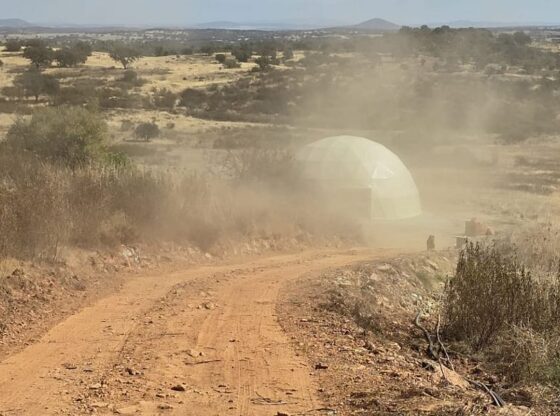

Monsaraz will host the first analogue mission carried out within a habitat on Portuguese soil, the “Monsaraz Mars Analog Mission”, which will take place from October 13th to 25th, and which aims to test conditions similar to those on Mars, in a habitat created in the outer space of the Lago Alqueva Astronomical Observatory.
During these 13 days, a team of scientists will carry out an integrated mission in the World’s Biggest Analog, “an international initiative that will conduct the largest proof-of-concept space simulation mission to prepare for living and working in space, uniting multiple habitats and collaborative research on Earth”explains Inesc Tec – Institute of Systems and Computer Engineering, Technology and Science.
“Portuguese participation marks a new step in Portugal’s consolidation on the international map of analogous space exploration”said the institution, in statement.
After “the success” of the Camões Mission, carried out in November 2023 inside the Gruta do Natal, on Terceira Island, in the Azores, “this new experience now takes the spirit of scientific exploration to the heart of Alentejo, where researchers and analogue astronauts will simulate conditions similar to those on Mars”.
The leadership of the project in Monsaraz, the operation and management of the habitat are the responsibility of the Lago Alqueva Astronomical Observatory, while scientific and technological leadership will be the responsibility of Inesc Tec.
The mission also has the support of the Os Montanheiros Association, leaders of Missão Camões.
“Over the two weeks of operation, diverse scientific experiments will be carried out and technologies will be tested, such as innovative software or drones, including projects in collaboration with international institutions”, explains the organization.
The Monsaraz Mission team, which will enter the habitat, is made up of three Portuguese researchers, Pedro Pedroso, Rafael Rebelo and Diogo Paupério, from the University of Aveiro and INESC TEC, respectively; and by two young scientists, Florence Basubas from the Philippines and Nadine Duursma from the Netherlands.
Inside the habitat, the mission will be led by Pedro Pedroso, aeronautical engineer, air traffic controller and analogue astronaut, ensuring the coordination of operations and the rigorous execution of scientific activities.
“Inesc tec, as in the Camões Mission, once again plays a prominent role, with the participation of researcher Ana Pires, the first Portuguese female astronaut scientist and commander of the Camões mission, who will lead the activities at the Mission Control Center, together with Slavka Carvalho Andrejkovicová, from the University of Aveiro and collaborator at NASA.
Inesc Tec researcher, Diogo Paupério, will be the mission’s “Flight Engineer/Robotics Specialist”.