
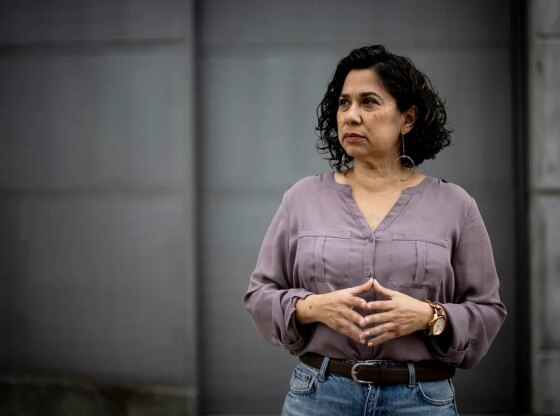

Four months after the murder in Costa Rica of Roberto Samcam, former major in the Nicaraguan Army and opponent of the Sandinista regime with Spanish nationality, his widow, sociologist Claudia Vargas, continues to “resist.” He does it with serenity, but with the weight of a denunciation that crosses borders and ideologies. In conversation with EL MUNDO, Vargas reviews the life and convictions of someone who was first a soldier “seeking peace” and then a dissident persecuted, exiled and murdered in circumstances that point to a political operation. He trusts the Costa Rican justice system, questions the silence and warns that the arm of Nicaraguan power no longer knows limits. “They can’t take anything more from us”he asserts.
- Do you trust research in Costa Rica?
- I trust the Judicial Power of Costa Rica. I trust the Judicial Investigation Organization (OIJ). I celebrate the words of the Attorney General, Carlos Díaz. When they speak and recognize that Roberto’s crime is a political crime, which has transnational traces; when they talk about the complexity of the case and say that it has been linked to organized crime. They vindicate all of us exiles because they know that there are similar patterns in other attacks. Recognition is a fundamental part that all Nicaraguans need. Roberto’s profile is so high in the media that he has exerted pressure to give a faster response.
- Is Roberto’s voice still alive in his complaint?
- I think Roberto’s voice has never been so alive as it is now. It is a legacy that he left me and that I assume with great consistency, because Roberto’s voice is a much bigger voice than mine.
- The role of the Army and the Sandinista Front seems evident in several murders inside and outside Nicaragua. Do you think then that the intellectual people responsible can now be pointed out?
- For us exiles, for all of Nicaragua, for those of us who are refugees somewhere in the world, We have no doubt that this is a transnational State crime, and that the dictatorship and the Army are behind it.. The pattern that was used, the audacity with which Roberto was killed all the way to our house. As for technique, the profile. There is an escalation. It had been rehearsing with other activists. Getting to the door of your house means that there were resources, surveillance, Intelligence. And it is not just any Intelligence. It’s military intelligence. We were under surveillance. They knew what they were doing. It was not a murder in the street. They caught him at home. And they had to do it quickly since Roberto spent many periods outside of Costa Rica. That is pure Intelligence. But it must be the OIJ and the Judicial Branch of Costa Rica who must reach that profile, to the perpetrators. The prosecutor has already said that the only line of investigation they have open in Roberto’s case is politics.although the dictatorship invents news to divert attention.
- With the influence of Daniel Ortega and Rosario Murillo extending even outside the country, what value do denunciation and silence have today?
- It is important, first of all, that we see this repressive scheme as an extension of the repression that is being experienced in Nicaragua.; It is not an isolated event. It is repressed in Nicaragua and it is also repressed in other countries such as Costa Rica and Honduras. While they were murdering Roberto, there was repression, there was a repressive surge, specifically in Carazo [departamento de donde es originario Samcam]. There were also awards for members of the Army and Police. The exile has taken on a very important and necessary spokesperson. For the regime, it is then necessary to stop civil society from outside, although they have not yet succeeded in doing so.
- Do you feel safe living in Costa Rica?
- No one is safe anywhere. The message is that you are not safe in any corner of the world. Roberto’s case has given me a lot of visibility. But I have an important protection scheme.
- Roberto was nationalized by Spain. Has the Spanish State shown any interest in the case?
- The Spanish State has not made a public statement so far.. But yes in a personal way. The former ambassador of Spain has already been to the judicial offices of Costa Rica [Eva Felicia Martínez Sánchez].
- At the time he mentioned that Roberto had frequent meetings with Costa Rican Intelligence agents. What did he know – and what do you know – about the presence of Sandinista cells in Costa Rica?
- A few months before Roberto’s murder, a documentary was published in which he denounced the presence of these cells, which are operating from the Nicaraguan embassy. People come and go from Costa Rica all the time. Costa Rican Intelligence was warned.