
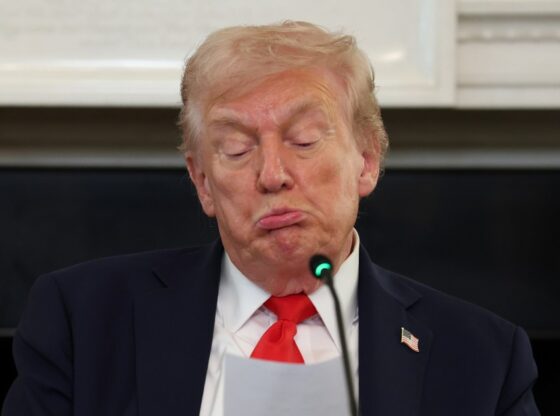

THE White House has lashed out at the Nobel Prize committee for not honouring Trump with the peace award.
President Trump was denied the Nobel Peace Prize even though his deal yesterday brought an end to the war between Israel and Hamas.

7

7
Why did María Corina Machado win?

MARIA Corina Machado is a democracy activist in Venezuela – and was barred from running in last year’s presidential elections by the government.
She is credited with driving the unification of Venezuela’s opposition to stand against dangerous, authoritarian power.
The Nobel Committee said the award was in recognition of her “tireless work” to protect rights and fight for a transition to democracy in Venezuela.
Announcing the winner, Jørgen Watne Frydnes lauded her as “a woman who keeps the flame of democracy burning amidst a growing darkness”.
He said: “When authoritarians seize power, it is crucial to recognize courageous defenders of freedom who rise and resist.”
Troubled Venezuela is currently ruled by Nicolás Maduro, who is widely recognised as a dictator.
His government routinely targeted those it viewed as an obstacle to its continued power – meaning Machado risked her life by speaking up.
Machado has thus been living in hiding for the past year, after her fearless work incited “serious threats against her life”.
The prize instead was awarded to María Corina Machado – a Venezuelan politician and activist – for her fearless fight against dictatorship in Venezuela.
The White House criticised the committee’s decision, saying it places “politics over peace”.
“The Nobel Committee proved they place politics over peace,” White House Director of Communications Steven Cheung said on X.
“President Trump will continue making peace deals, ending wars, and saving lives. He has the heart of a humanitarian, and there will never be anyone like him who can move mountains with the sheer force of his will.”
But the Venezuelan politician dedicated the Nobel Prize to the US President and thanked him in an X post.
She wrote: “This recognition of the struggle of all Venezuelans is a boost to conclude our task: to conquer Freedom.
“We are on the threshold of victory and today, more than ever, we count on President Trump, the people of the United States, the peoples of Latin America, and the democratic nations of the world as our principal allies to achieve Freedom and democracy.
“I dedicate this prize to the suffering people of Venezuela and to President Trump for his decisive support of our cause!”
Committee chair Jorgen Watne Frydnes explained why the US president was not given the award.
He said: “I think this committee has seen [every] type of campaign [and] media attention. We receive thousands and thousands of letters every year of people saying what, for them, leads to peace.”
“But this committee sits in a room with the portraits of all laureates and that room is filled with both courage and integrity. So, we base only our decision on the work and will of Alfred Nobel.”
The committee said it paid tribute to Machado’s “struggle to achieve a just and peaceful transition from dictatorship to democracy”.
She was described as “one of the most extraordinary examples of civilian courage” in recent times and credited with unifying the opposition.
President Trump has long dreamed of pocketing the prize, and previously warned it would be a “big insult” if he did not win.
He claimed last month to have extinguished seven conflicts around the world – with the Gaza war making eight.
All eyes were on the President’s nomination this year after he campaigned on his own behalf and numerous world leaders endorsed him for the honour.
He repeatedly insisted he deserves to take home the coveted golden medal, though also admitted he thought it unlikely.
And he ripped into Barack Obama last night, who won the award in 2009, fuming: “He got a prize for doing nothing.”

Yesterday, Israel’s Prime Minister Benjamin Netanyahu shared an AI-generated image of him awarding Trump the prestigious gong to endorse his greatest ally.
Even Vladimir Putin backed Trump to win.
The Kremlin warmonger said Russia supported Trump’s nomination, but only if he did not supply long-range Tomahawk missiles to Ukraine.
Trump’s snub comes the day after Israel and Hamas signed the peace deal Trump designed to end the war and return the hostages.
However, the final meeting of the Norwegian Nobel Committee was held on Monday – meaning the deal-signing wasn’t expected to be taken into account.
Erik Aasheim, spokesman for the Norwegian Nobel Institute, said this week: “The final touches were made on Monday, but we never disclose when the Nobel Committee makes its decision.”
Historian Asle Sveen, a specialist in the Nobel Prize, said the agreement between Israel and Hamas would have “absolutely no impact” on this year’s decision.
He claimed that Trump had “given free rein” to Israeli Prime Minister Benjamin Netanyahu to bomb Gaza – making his selection unlikely.
Trump the peacemaker: What are the world conflicts that have ended since Trump reentered the White House?
DONALD Trump has credited himself with helping to stop or mediate several world conflicts during his presidency. The conflicts he has mentioned include:
- Israel and Iran: Trump helped broker a ceasefire following Israeli strikes on Iranian nuclear facilities in what he called the Twelve Day War.
- Rwanda and the Democratic Republic of the Congo (DRC): He stated his administration’s efforts “stopped” the conflict in the DRC, although sporadic fighting reportedly continues.
- Armenia and Azerbaijan: Trump celebrated a “peace treaty” between these nations, though it was more of a political agreement than a legally binding treaty.
- Cambodia and Thailand: He claimed credit for ending a brief border conflict between these countries.
- India and Pakistan: Trump asserted his role in brokering a truce between the two nations.
- Serbia and Kosovo: Trump took credit for preventing a war between these nations.
- Egypt and Ethiopia: He claimed to have mediated a truce over the Nile River dam dispute, although no final agreement has been reached.
The President was undoubtedly the only person with enough influence over Benjamin Netanyahu to compel him to overcome his reservations.
He reportedly told the Israeli PM to stop being “so negative”, and made him see the benefit of downing arms.
Assuming all goes to plan, all of the remaining 48 hostages – dead or alive – will be returned to Israel by Monday.
Hamas will disarm and disperse, and Israel will begin withdrawing from the Gaza Strip.

7

7
Celebrations erupted on the streets of Gaza and Israel when the news broke on Thursday morning.
Many in Israelparticularly among the hostages’ families, credited Trump with securing peace and broadcast their gratitude.
Some of the families spoke to Trump on the phone soon after he announced “they’re all coming home”.
There were cries of “Thank you”, “You did it” and “This is amazing!”
One said: “Mr. President, we believe in you. We know you’ve done so much for us since you became the president.

7

7
“Even before that. And we trust you fulfilled the mission until every hostage, every 48 of the hostages, are home. Thank you so much. Blessed be the peacemakers.”
Those thanks and accolades evidently were not enough to convince the Nobel Committee that Trump’s record deserved the coveted prize – though could be taken into consideration next year.
Trump never made any secret of his peace prize ambitions.
He has repeatedly claimed there is an agenda against him which would prevent him ever pocketing the gold medal.
Trump said last year: “If I were named Obama I would have had the Nobel prize given to me in ten seconds.”
And in February: “They will never give me a Nobel peace prize. I deserve it but they will never give it to me.”
How is the Nobel Peace Prize winner decided?
By Patrick Harrington
THE WINNER of the Nobel Peace Prize is chosen through a highly-secretive deliberation process.
Every year since 1901, the Norwegian Nobel Committee has met to discuss who is worthy of taking home the prize.
Nominations close in January, and the Committee comes together throughout the next eight months to confer.
Its five members meet along with a secretary in the Committee Room of Oslo’s Nobel institute.
They read aloud the criteria set out by Alfred Nobel in his will.
It says the prize should be awarded to the person who has done the most for fraternity between nations, the abolition or reduction of standing armies, or for holding or promoting peace congresses.
Then, they enter intense discussions in order to thrash out the decision.
Committe Chairman Jorgen watne frydnes told the BBC: “We discuss, we argue, there is a high temperature.
“But also, of course, we are civilised, and we try to make a consensus-based decision every year.”
If there is no consensus over who should win, then it goes comes down to a simple majority vote.