
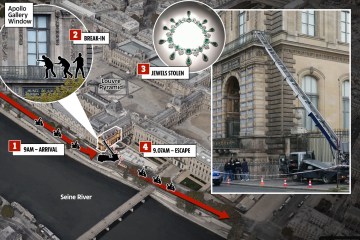

INVESTIGATORS are probing a theory that the Louvre loot was stolen at the request of a black market kingpin.
Parisian cops are desperately trying to hunt down the eight pieces of invaluable jewels nicked in the broad daylight heist which has “failed France”.
A top team of 60 investigators are looking for the perpetrators – and any co-conspirators – behind the brazen smash and grab on Sunday morning.
Police now believe they have just “24 or 48 hours” to catch the thieves.
Chris Marinello, the chief executive of Art Recovery International, told BBC Newshour: “If these thieves are not caught by then, those pieces are probably long gone.”
It comes amid serious fears that the jewels had been stolen so they could be sold off around the globe to the rich and wealthy via the black market where they will likely never be seen again.

Paris prosecutor, Laure Beccuau, described the team of four criminals who pulled off the robbery as a “strike team”.
She has speculated they could well of been working with a collector from the black market.
If true, the team would likely have been paid to conduct the raid by a national or foreign individual who ordered the pieces.
Ms Beccuau spoke about the potential organised crime factor as she said: “It can have two objectives: either to have acted for the benefit of a sponsor.
“Or to have acted with the objective of purchasing precious stones to carry out money laundering operations.”
The thieves managed to get away with priceless pieces including a tiara, necklaces and brooches that once belonged to Napoleon Bonaparte’s family.
Robbers often prefer items that can be broken up, melted or made smaller which can also be converted into cash – such as the jewels.
This is because things like crowns and diamonds can easily be broken apart and sold into several bits.
The final price might drop significantly compared to the entire historical jewel but it does allow for a safer and easier transaction if it goes to market.
If the Louvre’s famous artefacts are already in a safe house then it is possible that they have already been cut up, melted down or even sold in full.
List of looted treasures

THESE are the eight “priceless” pieces of jewellery stolen in the smash-and-grab raid on the Louvre museum in Paris
- Tiara from the set of Queen Marie-Amelie and Queen Hortense
- Necklace from the sapphire set of Queen Marie-Amelie and Queen Hortense
- Earring, from the pair belonging to the sapphire set of Queen Marie-Amelie and Queen Hortense
- Emerald necklace from the Empress Marie Louise set
- Pair of emerald earrings from the Empress Marie Louise set
- Brooch known as the “reliquary brooch”
- Tiara of Empress Eugenie
- Large corsage bow brooch of Empress Eugenie
Another item – the crown of Napoleon III’s wife, Empress Eugenie – was reportedly recovered from outside the window but broken.
This would ultimately make them far harder to track down as they would be spread further apart the globe and near impossible to trace back to the original item.
Mr Marinello believes the items will be unrecognisable anytime in the next 48 hours.
He said: “They are not going to keep them intact, they are going to break them up, melt down the valuable metal, recut the valuable stones and hide evidence of their crime.
“They may catch the criminals but they won’t recover the jewels.”
Paris has been left stunned by the simple nature of the attack on the Louvre.
It took just seven minutes for a chainsaw-wielding gang to get inside and steal tens of millions worth of jewellery.
The gang – described as a “highly organised commando unit” made up of four – were last seen disappearing on two Yamaha mopeds through the French capital.
France’s Justice Minister Gérald Darmanin glumly announced on Monday: “We failed and presented a deplorable image of France.”
Has the Louvre been targeted before?

SUNDAY’S robbery is far from the first time France’s most well-known museum has been targeted.
Farewell Mona Lisa
On August 11, 1911, the Mona Lisa became the focus of one of the most audacious robberies of the 20th century.
Vincenzo Peruggia, an Italian immigrant who had briefly worked at the museum, walked into the Louvre unchallenged dressed in his old work uniform.
Peruggia took the painting off the wall and walked out with it under his top.
No one noticed for 24 hours as workers believed it had been moved for conservation or photography.
A year of robberies
1976 saw multiple strikes by gangs inside the Louvre.
In January, burglars pinched a Flemish painting from the museum.
In December of the same year, masked men burgled a jeweled sword once owned by French King Charles X.
They accessed the museum from a second-floor scaffold with the sword yet to be recovered.
A decade of security blunders
The 1990s saw another three thefts take place within the museum’s walls.
In 1990, thieves took a small Renoir painting as they cut it from its frame in broad daylight.
Along 12 pieces of ancient Roman jewellery and a few other paintings were also taken.
Five years later, two objects were stolen in a single week and prompted a major security increase.
It ultimately proved fruitless as in 1998, a Camille Corot painting was cut from its frame and disappeared.
It has yet to be recovered.
President Emmanuel Macron described the robbery as an “attack on a heritage that we cherish because it is our history“.
He vowed to do all he could to locate the jewels and return them to Paris.
As new Interior Minister Laurent Nuñez acknowledged Sunday highlighted a “major weak spot” in the museum’s security.

CRASH TRAGEDY
England icon Stuart Pearce’s son, 21, killed in tractor crash

‘GUT-WRENCHING’
My little girl is slowly fading before my eyes and will die before she’s 10
Security measures across all of France’s cultural institutions will now be tightened in response.
Several questions still remain over one of the biggest heists in a century with a hunt for answers set to continue for some time.