

IMAGINE holding an AK loaded with real bullets for the first time — the power to kill in your hands — and not knowing what to expect.
Will you be able to handle the recoil? Will you go deaf from the sound? And the biggest question – will you be able to handle this mentally?
At first, it’s all about getting used to pulling the trigger and keeping the weapon steady. Safety rules become your new religion.
Under no circumstances should you point your weapon at another person — unless you intend to kill.
During tactical fire exercises, when you move between positions, you must always stay behind your brother-in-arms’ muzzle.
There’s a strange beauty in night shooting — the fire blooming from your rifle’s barrel with every shot, like a flower made of fire.
DRUG BLAST
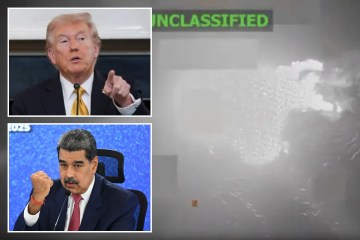
Moment Trump bombs ANOTHER drug smuggling boat killing three ‘narcoterrorists’

HELL ON EARTH
Sudan militia slaughter children in front of parents in ‘apocalyptic’ city
In boot camp, your rifle becomes your new best friend.
You don’t part with it. You eat with it, shower with it, leaving it next to the cabin, and sleep with it — because you must always be ready to use it if you’re ever on the frontline.
Some people named their rifles. I didn’t. I keep names for living beings.
At 40, I signed a voluntary contract with the Ukrainian Navy. I wasn’t conscripted. I was an overweight civilian — 105 kilos — with a very vague idea of what to expect.
Boot camp lasted 49 days and completely changed me. It stripped away my old life, mindset, habits and transformed my body.
In boot camp, you lose touch with your previous life.
Mobile phones are taken away, and your family is given the number of the duty officer for emergencies. It’s done mostly for security reasons. You’re allowed to use your phone once or twice a week for a short time to make an emergency call.
Alcohol is, of course, forbidden — but you can smoke.
In the evenings, after long days of training, we gathered together: a motley crew of men aged 22 to 52, from different backgrounds and walks of life. We talked, listened to each other’s stories, got to know one another — and smoked.
We learned how to detect and avoid booby traps, how to provide tactical medicine, storm trenches and buildings – and practised shooting with AK rifles, machine guns, shotguns, and throwing grenades,
We crawled under a running tank while hiding in a trench, and under low-stretched barbed wire. It was dangerous, terrifying and exciting at the same time.
The downside? I can’t watch fighting scenes in blockbuster movies without laughing anymore.
When heroes do impossible stunts with weapons, I can’t help but think — had they done that in real lifethey’d be dead in seconds.
The Navy boot camp is far from Disneyland. It’s designed so that through hardship, sweat, and blood, you rediscover and reinvent yourself.
During my first two weeks, I thought I would die.
My 105-kilo body protested with pain in every nerve, begging me to return to my comfortable civilian life.
I will never forget my first few-kilometre march in full military gear.
We carried about 25–30 kilos of extra weight: body armour, a backpack with 3–6 litres of water, and an AK rifle. And it was a southern Ukrainian summer where temperatures reach 40°C.
Every cell in my body was screaming. Collapsing seemed inevitable.
But that’s when true teamwork revealed itself. The guys from my unit cheered me on, poured water on my neck, and helped me keep going.
Every step felt like my last, yet I made it — because I wasn’t alone. That’s when you truly understand the value of brotherhood and trust.
The next march was hell, too — but that hell became manageable.
That’s when I learned that character matters more than muscles.
Pain doesn’t kill you. Weakness can. That’s a lesson I’ll carry for the rest of my life.
Air raid alerts in boot camp have a different taste. In the city, you learn to ignore them.
But here, you might be the target — so you take them seriously. No matter what you’re doing, when the alarm goes off, you run for cover.
Once, it happened while I was in the shower. I wrapped myself in a towel, grabbed my rifle, and ran like that.
War is a massive challenge to mental health. It leaves a mark on everyone, one way or another. Its legacy will stay long after it ends — perhaps for the rest of our lives.
I have seen war through many perspectives: as a civilian, a humanitarian, a military journalist, and now through the scope of a serviceman.
As a civilian, I experienced overwhelming dismay and sheer helplessness — being forced to watch the misery and destruction brought by the Russians.
As a humanitarian, I tried to do whatever little I could to ease the suffering of people in Kherson, Mykolaiv, and forgotten de-occupied villages — and to save the silent victims of war, the stray animals trapped in flooded Kherson after the Russians blew up the Kakhovka dam.
As a military journalist, travelling to the frontlines, I felt hope watching the bravery and courage of Ukrainian soldiers — men and women who give everything to stop the enemy and protect our people.
As a serviceman, I found something I never expected to find in the army — a strong sense that, finally, things made sense.
You discover the true meaning of army brotherhood, where everyone stands for everyone.
It’s a powerful feeling when you know these guys stand for you – and you stand for them.

COST CUTTER
John Lewis launches early Black Friday sale a MONTH early with up to £300 off

SPY STORY
Telltale clues CHEATERS use to spot you secretly reading their dodgy texts & pics
Your unit becomes your family for life — no matter how many units you serve in later.
Inside Ukraine’s recruiting crisis

By Jerome Starkey, Defence Editor
A DULL-eyed soldier at a roadblock stopped our car and demanded papers.
This is not unusual in Ukraine. Almost four years after Russia’s invasion, checkpoints are a fact of life, like bomb shelters and air raid sirens.
But this was different. Within a few exchanges it was clear something was wrong.
As a foreign journalist in a war zone I am used to attracting scrutiny and occasionally suspicion. We are often driving the wrong way — towards trouble — clad in helmets and body armour.
Uncertain soldiers search our car. Some take pictures of our press credentials to WhatsApp to their bosses.
After the Russian invasion in February 2022 I was held up at gunpoint and ordered out of my vehicle with a rifle levelled at my pounding heart.
It was the first week of the war and strung-out soldiers with little experience of journalists were paranoid that we might be Russian saboteurs.
Usually when we say we are British we get a smile or a cheer, sometimes even a “Boris Johnson!” salute, before being waved on our way.
It is not lost on Ukrainians that Britain has been their chief flag-waver, the first to donate tanks and cruise missiles.
Not this time. No smiles. No jokes. Instead, we were about to witness the ruthless side of Ukraine’s recruiting crisis.
Read the full story here.