
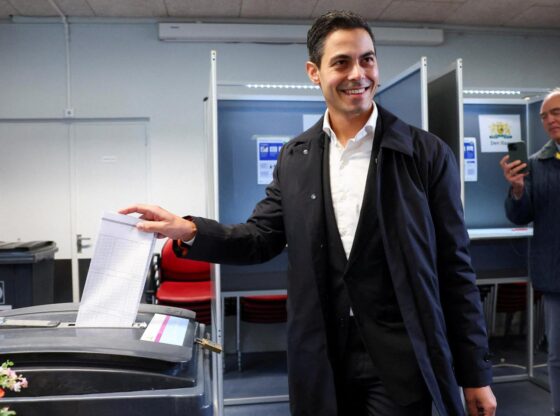

Up to three candidates left this Wednesday with serious options to unseat the far-right Freedom Party (PVV) of Geert Wilders as the leading political force in the Netherlands. The social democrat Frans Timmermans (PvdA-GroenLinks), el socioliberal Rob Jetten (D66), the Christian Democrat Henri Botenbal (CDA), launched in the polls, aspired to snatch first place from the ultras.
It is Jetten who is finally emerging as the winner of these early elections, according to the exit polls published this Wednesday at the close of the polling stations, which attribute 27 seats to his party, two more than Wilders’ party.
The popularity of Jetten, who at 38 years old is on his way to becoming the youngest and first openly gay prime minister of the Netherlands soared last month with a campaign with a positive message in the style of “Yes, we can”that promised the end of the political era dominated by Wilders.
The brief period in government of Wilders’ nationalist, anti-immigration PVV party appears to have come to an end for now, as The traditional parties, from the left to the right, have closed the door to joining a coalition with them.
Exit polls are usually accurate. The margin of error is small, but the Netherlands Electoral Council (Kiesraad) will not confirm the results until Friday, according to its spokesperson. Anita Pronkwhich had warned that the uncertainty could last well into the early hours of Thursday.
The scrutiny of the 2010 legislative elections remains in the collective memory of the Dutch. Until late at night it was not clear that the conservative liberals of Mark Rutte had been imposed on the Labor Party Job Cohen by a narrow margin.
The timid percentage of participation—only 48 percent of the 13.4 million voters had gone to the polls before 5:55 p.m., according to public radio and television NOS— predicted that the turnout at the polling stations would remain two points below the November 2023 elections, in which 77.8 percent of the electorate voted.
In recent days, the parties had gone on the hunt for the undecided vote. Two thirds of the electorate were not clear about the meaning of their vote two weeks before the elections. The percentage fell this week to 38 percent, according to the survey RTL News panel.
Jetten will have to reach the magic figure of 76 seats in the House of Representatives in The Hague. They will have to agree with four or five other formations to achieve it.
The negotiations promise to last several weeks. The process begins when the winner of the elections proposes the name of an explorer or scoutresponsible for determining which formations can articulate a coalition based on parliamentary arithmetic.
When the scout carries out his task, passes the baton to the informanta consensus figure who leads negotiations and draws up a preliminary coalition agreement.
If the negotiations are successful, the informant presents the final coalition agreement and appoints the trainerwho is usually the prime minister. It is this who formalizes the rest of the Cabinet appointments. The process ends with the traditional visit of the ministers to King William Alexander.
The outgoing prime minister, Dick Schoof, presented his resignation on Wednesday morning to the monarch, who said he had taken his request “into consideration”, but the former spy chief, with a Labor past, will continue to govern in office until the formation of the next Executive.
The record duration of coalition negotiations stands at 299 days. The last ones, piloted by Wilders’ PVV, lasted 223 days, just over seven months.
The Popular Party for Freedom and Democracy (VVD, liberal-conservative), the New Social Contract (NSC, Christian Democrat) and the Peasant-Citizen Movement (BBB, agrarian populist) participated in that coalition led by the far-right. Three formations harshly punished this Wednesday at the polls.
Wilders, vetoed by his coalition partners to serve as prime minister, left the Cabinet last June after denouncing his own Cabinet’s inability to toughen asylum laws.
A month later, it was the NSC ministers who left their positions as a sign of disagreement with their government partners over the lack of sanctions against Israel for its war in Gaza.