
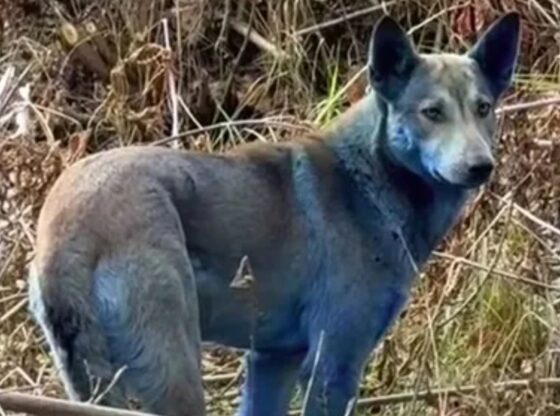

A BIZARRE mystery is unfolding in the radioactive ruins of Chernobyl — where several stray dogs have inexplicably turned bright blue.
Footage shared by organisation Dogs of Chernobyl shows three blue-tinted hounds roaming near the infamous power plant.
“We’ve seen a lot in Chernobyl,” a spokesperson said, “but this was a very unique experience.”
The group — affiliated with the non-profit Clean Futures Fund — says the animals are descendants of pets abandoned nearly 40 years ago after the 1986 nuclear disaster.
“We are on the ground now catching dogs for sterilization, and we came across three dogs that were completely blue,” the group said in an Instagram post that’s racked up more than 330,000 views.
“We are not sure exactly what is going on.”
Locals told the team the animals’ fur looked normal just a week earlier.
“We do not know the reason, and we are attempting to catch them so we can find out what is happening,” the spokesperson added.
“Most likely, they’re getting into some sort of chemical.”
Despite their shocking colour, the charity said the animals appeared “very active and healthy.”
The Dogs of Chernobyl project, launched in 2017, provides medical care, food, and sterilization for around 700 stray dogs that roam the 18-square-mile exclusion zone.
The area still off-limits to most humans since Reactor No. 4 exploded in 1986, in one of the worst nuclear disasters in history.
The appearance of the blue hounds has nothing to do with radiation, experts say.
But it comes as scientists continue to study how decades of exposure inside the Chernobyl Exclusion Zone may have changed these canines on a genetic level.
A 2023 study published in Science Advances by scientists from the University of South Carolina and the National Human Genome Research Institute analysed the DNA of 302 feral dogs living in and around the exclusion zone.
They found remarkable genetic differences compared to dogs just 10 miles away — suggesting the animals may be evolving faster.
Co-author Elaine Ostrander told The New York Times: “Do they have mutations that they’ve acquired that allow them to live and breed successfully in this region?
“What challenges do they face and how have they coped genetically?”
The research hinted at rapid adaptation but didn’t prove radiation was the cause — and later studies found no clear evidence of mutation from radiation exposure.
Still, scientists say the dogs’ resilience is astounding.
Further research led by Dr. Norman J. Kleiman at Columbia University found that two distinct dog populations — one around the power plant and another in Chernobyl City — have managed to survive generations of contamination.
“In addition to classifying the population dynamics within these dogs at both locations, we took the first steps towards understanding how chronic exposure to multiple environmental hazards may have impacted these populations,” Dr. Kleiman said.
Another researcher, Dr. Matthew Breen from North Carolina State University, told Science News: “The overarching question here is: does an environmental disaster of this magnitude have a genetic impact on life in the region?”
Some of the dogs carry genetic markers linked to DNA repair — possible clues to how life adapts in extreme radiation zones.
“They identify areas within the genome where we should look more closely at nearby genes,” Dr. Breen explained.
While no “mutant super-dogs” have been confirmed, scientists believe studying the Chernobyl hounds could one day help humans understand how to protect themselves from radiation exposure — even in space.
Chernobyl’s stray dogs — along with wolves, elk, and even black frogs that evolved darker pigmentation — have turned the exclusion zone into a living laboratory for evolution.
Wildlife has flourished in the absence of humans, hunting, and industry.

RING GIRL
Paris Fury lets slip unknown details about daughter Venezuela’s wedding plans

GROUNDED
UK airline with 1.3m passengers on brink of administration and axes ALL flights
“To think of families living in places like near spent fuel rods is incredible and speaks to the resilience of dogs as a species,” Ostrander said.
“We can see the history of those pets etched in the DNA of dogs living in the exclusion zone today.”