

Isabel de Navascúes and Urquijo has written and published a book called The insolent youth. Reflection and urban chronicle in Madrid at the end of the century: LOVE, sex, drugs and electronic music (2025) which portrays the rogue Madrid that goes from 1999 a 2001. When we use the word ‘canalla’ in this context we do so in reference to the ‘posh-canalla’ area, something to be taken for granted if we look at the surnames of its author.
Her book, an autobiographical novel, portrays “a Madrid in which you went out during the week just as you went out on the weekends,” she says.
“During the week it was more cool because it was more diverse and everything was not so crowded. You had the opportunity to go to bars any day of the week. We liked one where they played what we called ‘old music’, which was techno-pop, EBM, synth pop… that medley of music that was played in the Ruta del Bakalao. The joint we went to during the week was the Cavaa small bar on Castillo Street, near Olavide. There I clicked Álvaro Scratcha guy who had very special, exclusive albums.”
Another leisure area on those weekday nights was Chueca, where there were numerous bars. “At that time there were still a lot of junkies,” recalls the writer. “After Cava we often went to the Mythin Chueca, or at the piano bar, on Almirante Street [Toni 2]. Other areas in which to alternate during the week were Moncloa and the lower parts of Orense, where the Speck [que sigue abierto a día de hoy]. After the Specka, you had the Fun Factory and then the Streak and the Roxywhich were both afters“. Institutional conditions then existed that allowed going out in another way. According to Isabel: “There was a legal vacuum between closing and opening hours. There was a cafeteria license to open at six in the morning, which allowed the establishment to operate as after“.
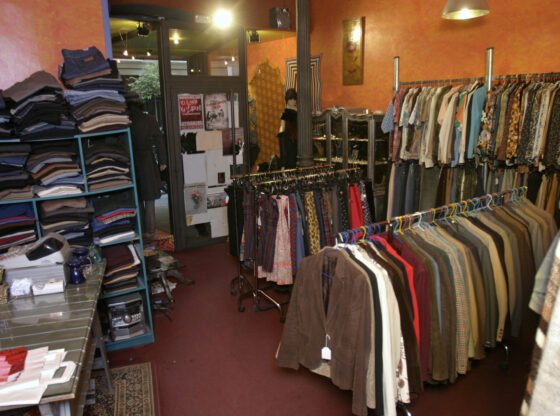
When it came to dressing, in those years there was not as much variety as today. “To dress more cutting-edge,” recalls Isa, “you had to go to the Rastro or vintage stores. A reference store that is still open was Susu Templein Malasaña. It was a vintage clothing store, which was then called ‘second-hand’. With the arrival of the Fuencarral Market there was a change in the forms of leisure and, thanks to this, electronic music became more mainstream. Until then, the Bakalao Route had given electronic music very bad press. Although this was linked to the consumption of certain substances, today we see that almost all nightlife is linked to certain types of consumption.”
The Malasaña store the Susu Temple.
An omnipresent figure in Isabel’s novel is the dodgy posh. She estimates that this archetype is a product of the quinqui cinema of the 70s and 80s: “I believe that this type of cinema romanticized petty crime, and that phenomenon was distilled to end up becoming a fashion. You had to be careful and not leave the keys in the motorcycle because you would turn around and the motorcycle was not there. And I’m talking about the posh world. It was full of smart people looking for their opportunity to commit a crime. I remember walking down Padre Damián Street, a guy got off his motorcycle and stole my clothes. Ray-Barn Balrama. “He took them from me and took them.”
Marijuana and hashish
He continues: “At that time it was also very common to have several friends who they grameated [vender gramos de cocaína] or that they sold joints. In the 90s people smoked record [hachís más duro y de peor calidad] until many young people began to get down to the moro to eat hashish eggs. As for marijuana, until 2000 it was not very common to see it, except among people who grew it at home.”

La Joy Eslava on New Year’s Eve 1997.
Isa remembers that “in the park at the bar Skinny Jim [parque de Sangenjo] “You could get anything.” The consumption of ecstasy was common in those years with pills such as star caps, little birds, rhombuses, oval pills, enamelled ones, etc. Another place at the time where Isa and her friends went was the Freshin Alberto Aguilera. “Some people would play there, who would later play at the Quick,” Isabel recalls, “which is the joint I talk about the most in my novel.
The Quick had it Israel Bayonwhich now wears the Fortune. Another mythical place was Oh Madridon the Coruña highway, which was supposed to be Miami territory. One of my friends was with one of them. In fact, a status symbol for many girls of the time was having a bad boyfriend. He Quick It was a posh, badass joint where they played electronic dance, cantaditas…People went quite a bit putting. You went down some stairs, there was a bar on the left, a large court in the middle with sofas around…”.
Around that time they arrived the Bulgariansalso known as the rib breaker. “They opened the doors of several gambling dens and that was truly frightening,” she says. “They were people who came from Eastern Europe and had a different concept of what violence was. They would slap an aunt as well as an uncle and things like that… In those years there was smoking in the clubs and there were those who would take the opportunity to roll a joint. But, if a Bulgarian caught you, he would slap you and throw you out of the place”
The insolent youth (2025) is an essential text for anyone interested in rogue Madrid at the end of the century, a realistic and raw text about the capital in those years that will not leave anyone indifferent.
He is the author of Intersecular macarasedited by Melusina, [puedes comprar el libro aquí], Macarrismedited by Akal, [puedes comprar el libro aquí], Iberian macaroonsedited by Akal, [puedes comprar el libro aquí]the The true story of the Moco Panda. [puedes comprar el libro aquí] y San Vicente Ferrer 34 [puedes comprar el libro aquí].