
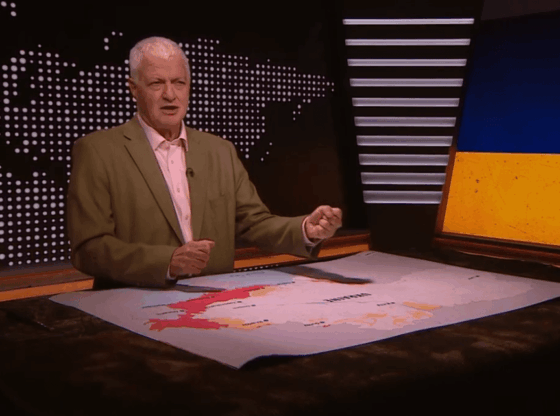

WHILE bullets and bombs fly on the frontline, The Sun investigates the war of deception Vladimir Putin is waging as part of his invasion of Ukraine.
In the latest episode of Battle Plans Exposed, military analyst Philip Ingram examines the “smoke and mirrors” strategies being exploited by the Russian tyrant.

14

14

14
The former Nato planner reveals how the relentless meatgrinder and drone strikes pale in comparison to disinformation and deception tactics being deployed by Russian forces.
Fake armies, ghost signals and espionage are all examples of Putin’s war of “trickery and deceit”, the expert says.
Watch the latest episode of Battle Plans Exposed here…
“All warfare is deception, all deception is warfare,” he claims.
He also sheds light on Russia’s information war, which sees Mad Vlad manipulating his own population – as well as the entire world.
“Russia‘s global information war and core part of its military doctrine is designed to shape world opinion and justify its aggression,” he reveals.
Ingram then lays bare the underhanded tactics being utilised in Putin’s war – including inflatable tanks and fighter jets painted onto airfields.
Finally, the expert reviews historical case studies – such as the D-Day landings and Operation Mincemeat – in order to highlight just how important deception is.
At the start of the newest episode, Ingram highlights how modern-day technology has “supercharged” this ancient strategy, which is now creating an “unseen war”.
“This is the truth behind the lies,” he says.
The military intelligence officer firstly analyses how Russians use invisibility cloaks to avoid the sight of Ukrainian drones.
But he emphasises that these jackets do not remove heat signatures, and are therefore not as effective as many think.
Ingram also explains “false flag operations” – attacks which are orchestrated by Russia but then blamed on Ukrainians.
Putin’s forces use mass disinformation campaigns and social media to convince locals that Ukraine is behind assaults on civilian infrastructure.
The expert then takes a deep dive into espionage efforts being carried out by both Ukrainians and Russians.
He shows an example of a Russian patrol taking in a Ukrainian soldier who pretends to be one of Putin’s pawns – before dealing with the group in a graphic attack.
Ingram also takes a look at examples of Ukrainian spies working in Russia disguised as old grannies.
Outlining the parameters for the war of deception being fought by Russia and UkraineIngram says: “Both sides are masters of creating ghost armies.
“A soldier’s biggest enemy isn’t always flesh and blood. It’s a fake.”
He goes on to investigate a frequently used tactic of using inflatable tanks to trick the enemy into thinking there is a real threat.

14

14

14
These decoys can force opposing sides to waste missiles worth millions of pounds, while also revealing enemy locations.
Ingram says: “It’s a simple but brilliant way to deplete enemy ammunition and expose their positions.”
He warns that each fake vehicle needs to have a heat signature to look convincing.
“Of course, it looks good visually, but as we saw in some of the earlier videos, there are thermal images,” Ingram says.
“So your blow-up tank has to have a thermal signature, like a real tank.”
He also tells how fake tanks are cheaper than deploying real ones, and have the advantage of not putting any personnel at risk.
Ukraine have even taken this game to a whole other level – by creating fake armies of HIMARS rocket launchers.
These game-changing long-range artillery units are huge targets for Russia, who desperately try to combat their devastating impact.
Ingram adds that these “incredibly detailed decoys” were placed in convincing positions which tricked Russians into firing multi-million pound cruise missiles at “what was essentially a garden shed”.

14

14
He says, “It’s estimated that for every ten missiles Russia fired at a Himars, at least four hit a worthless decoy.”
Ingram adds: “This is a modern tactical deception, fooling the enemy into fighting ghostsbankrupting them whilst the real weapons get ready to strike.”
He then goes on to describe the operational deception being employed in the war.
“Technology is used to blind and confuse the enemy, deceiving sensors and intelligence,” the analyst reveals.
He tells how Russia deploys “electronic warfare systems” which create “fake bubbles of GPS signals, drones and guided missiles”.
Those flying into this bubble can then suddenly lose their way and be set off course.
“It’s an invisible shield, a digital minefield that can stop some of Ukraine’s smartest weapons dead in their tracks,” he tells.
In a bombshell revelation, Ingram also explains Putin’s recent Nato airspace incursions across several European countries, including Estonia and Poland.
“It’s a classic decoy,” Ingram says.
“He’s deliberately trying to sap Western time, money and resources away from the real war in Ukraine.”

14

14
The expert lays bare how politicians become tied up in urgent meetings as a result of Putin’s “dangerous game of chicken”.
Ingram also takes a look at the Salisbury poisonings which took the life of Dawn Sturgess in 2018 following a botched Russian assassination attempt on UK soil.
He tells how Russian disinformation sowed doubt in British politics, creating confusion and fracturing the UK’s stance against Russia.
Ingram then explains the “highest level of strategic deception”.
“This isn’t just about fooling a soldier or a spy – it’s about fooling the entire world,” he says.
Putin targets the international community aiming “to sow division and doubt”.
“The entire pretext for the invasion was a strategic lie,” Ingram explains.
“The false claims of denazification and genocide against the Russian-speaking population in Ukraine.”

14

14
Ingram then examines when the level of strategic deception began – and identifies its roots in World War II.
He takes a look at how the Allies created a fictional army as part of one of the most ambitious deception plans in military history – Operation Fortitude.
Building hundreds of inflatable tanks and dummy landing crafts, the Allies worked to deceive German forces.
Looking back, the military expert says: “The goal was to convince Hitler that the main invasion would come at Pas-de-Calais, the shortest sea crossing, but the real invasion of Normandy was to be presented as a mere diversion.”
He also analyses Operation Mincemeat, telling how it was one of the most audacious missions in the Second World War – which successfully tricked German forces.
And Ingram also cites a more recent example of deception in Kosovo, which cost Western allies huge amounts of money when using anti-radiation missiles.
Concluding, Ingram says: “From the inflatable tanks of World War II to the digital ghosts of today, the battle plans of deception have evolved, but their purpose remains the same.
“To confuse, to paralyse, and to manipulate your enemy.”
He adds: “The war in Ukraine has shown that modern conflict is a hybrid war, both on the battlefield and in the global information space.”
Ingram emphasises: “Tactical deception saves lives.”

14