
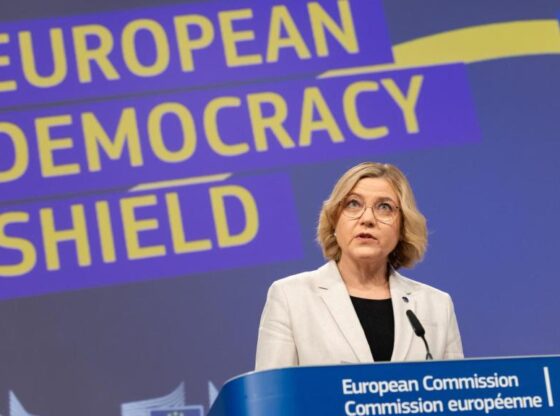

In his inauguration speech for his second term, Ursula von der Leyen promised the European Parliament as one of its star initiatives a ‘European Shield of Democracy‘ to counter the disinformation spread by Russia and amplified by the large American digital platforms.
Von der Leyen considered it a priority to improve tools for the early detection of “los deepfakes -fake images of politicians created with artificial intelligence- that have affected elections across Europe”.
A year later, the president of the Commission has presented her long-awaited Shield of Democracy, which beyond the attractiveness of the slogan is limited to a list of good intentions and repackaging of already existing initiatives, with few new concrete measures and no specific budget.
Even so, Von der Leyen maintains that this initiative “will reinforce the fundamental elements that allow citizens live our shared democratic values every day: freedom of expression, independent media, resilient institutions and a dynamic civil society.”
In the design of this Shield of Democracy, Brussels has been cautious for fear of unleashing the wrath of the president of the United States again, Donald Trumpwhich has threatened the EU with additional tariffs if it implements its digital rules (Digital Services Law and Digital Markets Act) to American technology giants.
In fact, the vice president of the Commission responsible for Technological Sovereignty, the Finnish Henna Virkkunenhas refused to clarify when it plans to approve sanctions against X, Elon Musk’s platform which it has been investigating for two years now for spreading illegal content and disinformation.
“These are new laws and it is really necessary gather all the evidence before making any decision“said Virkkunen during the press conference to present the Shield of Democracy.
The vice president of the Commission responsible for Digital Sovereignty, Henna Virkkunen, during the press conference this Wednesday
The truth is that the leaders of the large platforms, starting with Musk himself, They have allied with Trump in this legislature to combat European digital laws.
The vice president has also been asked about the fake videos that members of Viktor Orbán’s Government are spreading about the opposition leader in the face of the April 2026 elections in Hungarybut it has also not been able to specify new measures beyond those already planned.
“Under the Digital Services Act, platforms have an obligation to constantly assess and mitigate the systemic risks they pose to electoral processes,” Virkkunen said.
In this area, the Democratic Shield only plans to “promote the development of tools to detect content generated or manipulated with artificial intelligence –like the deepfakes who impersonate politicians– and to identify new patterns of coordinated behavior in networks, from the use of bots to algorithmic amplification.”
The Commission will also present guidance on the responsible use of AI in electoral processes and will update the Digital Services Act electoral toolkit.

But at the same time, Von der Leyen’s team plans to approve next week a series of proposals to make more flexible and delay the application of the pioneering regulation on Artificial Intelligence, bowing to intense pressure from the platforms and the Trump administration.
The most concrete measure of the plan is the implementation of a European Center for Democratic Resilience, whose objective will be facilitate information exchange and support capacity development against common threats, in particular the manipulation of information and foreign interference and disinformation.
However, Brussels does not detail the staff that this Center will have, nor its budget, nor its location, nor the deadlines to launch it. The Center will also be based “on the voluntary participation of the Member States”.
Also announced is a independent European network of fact-checkersas well as reinforced financial support for independent and local journalism, but again without giving figures or dates.