
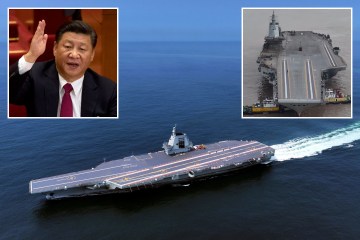

CHINA has taken its naval power to new heights as it officially commissioned its biggest and most advanced aircraft carrier.
The Fujian, a 1,000ft and 80,000ton supercarrier was debuted in a high-profile ceremony attended by Xi Jinping.
It entered active service with the People’s Liberation Army Navy (PLAN) on Wednesday on the island of Hainan in the South China Sea.
The move cements China’s place as the world’s second-largest carrier force as Beijing aims to rival the US in naval supremacy.
The carrier’s name also brings a pointed message.
Fujian is also the name of the province directly across from Taiwan – just 80 miles wide at its narrowest point – making the ship’s christening a symbolic statement of China’s claim over the self-governing island.
RED SEA
China’s biggest & most advanced warship steams past Taiwan in chilling message

FIGHTER OF THE FUTURE
Moment China tests new J-36 stealth jet in VERY public show of force
The Fujian is the PLAN’s third carrier and its first fully home-designed supercarrier, following the Liaoning and Shandong.
Its induction marks the biggest leap yet in China’s naval modernisation drive.
Xi personally decided that the Fujian would adopt the electromagnetic catapult system, state media reported.
More than 2,000 personnel from the navy and the ship’s construction teams were present at the commissioning, which state outlet Xinhua described as “grand and enthusiastic.”
After the ceremony, Xi boarded the Fujian, inspecting its flight operations centre and signing the ship’s logbook as a symbolic gesture of command.
The Fujian is the first Chinese carrier equipped with electromagnetic catapults, allowing it to launch heavier, more advance aircraft.
These include the J-35 stealth fighter, J-15T multirole jet, and KJ-600 early-warning plane.
That makes the PLAN only the second navy in the world after the US to field EM catapult technology.
Experts say the system allows faster, more efficient aircraft launches while reducing stress on both planes and the ship.
But unlike America’s nuclear-powered carriers, the Fujian still relies on conventional propulsion, giving it a limited range of 8,000–10,000 nautical miles.
The Fujian’s EMALS launch system puts it in direct competition with the USS Gerald R. Ford, the US Navy’s newest carrier and the only other vessel in the world using the same technology.
The Chinese ship has three catapults and two aircraft elevators, compared with the Ford’s four catapults and three lifts – a setup analysts say gives the American ship faster sortie rates.
The ship’s full-load displacement exceeds 80,000 tons, making it smaller than the 100,000-ton USS Gerald R. Ford, but way larger than its predecessors.
Analysts estimate it can carry 40-60 aircraft, marking a major increase in striking power for China’s expanding navy.
The Fujian will operate under China’s Southern Theatre Command, extending Beijing’s reach across the South China Sea and deep into the Pacific Ocean.
The vessel’s commissioning comes after an aggressive military parade in Beijing in September where Xi, flanked by Vladimir Putin and Kim Jong-un, unveiled new hypersonic weapons, laser cannons, and robot dogs.
The spectacle marked China’s push to display its growing military might on the global stage.
Analysts note that China’s broader buildup has been staggering.
Between 2019 and 2023, Beijing built around 40 new warships – roughly equivalent to the entire Royal Navy’s battle fleet – and now operates 405 vessels compared with America’s 295.
Though China’s fleet is larger by number, the US still dominates in tonnage and carrier capability with 11 active carriers, each capable of carrying up to 20 more planes than the Fujian.
Beijing isn’t stopping here.
A fourth carrier, reportedly under construction in Dalian, is believed to feature nuclear propulsion, though its details remain secret.
If confirmed, it would mark China’s move into true US-style supercarrier territory.
Taiwan tensions
The Fujian’s debut also comes after the carrier was spotted sailing past Taiwan earlier this year during sea trials, in a chilling show of force.
At the time, state media insisted the voyage was part of “routine testing,” but the carrier’s presence in the Taiwan Strait, flanked by guided-missile destroyers, sent a clear signal.
The passage came just as the Canadian frigate Quebec and Australian destroyer Brisbane made a joint transit through the same waters, drawing sharp condemnation from Beijing.
Chinese defence officials later confirmed the Fujian’s Taiwan Strait transit, saying it was conducting “scientific research trials and training missions” in the South China Sea.
The manoeuvre took place amid escalating regional tensions as Beijing expands its maritime footprint to rival Washington and its allies.

BILL PAIN
Two of UK’s biggest networks to raise prices for mobile and broadband customers

MUD, SWEAT & TEARS
Joe Marler’s wife’s secret struggle after saving rugby legend’s life
Xi has repeatedly called for “reunification” in Taiwan – by force if necessary – and experts warn that the Fujian’s debut adds new muscle to those ambitions.
Military analyst Philip Ingram MBE said Xi has positioned the island’s takeover as “a core part of his vision,” warning that China “reserves the right to use force.”
Why does China want Taiwan?

by Sayan Bose
TAIWAN insists it is an independent nation after splitting from mainland China amid civil war in 1949.
But China claims Taiwan remains a part of its territory with which it must eventually be reunified – and has not ruled out the use of force to take the island and place it under Beijing’s control.
The island, which is roughly 100 miles from the coast of south-east China, sees itself as distinct from the Chinese mainland, with its own constitution and democratically-elected leaders.
Taiwan sits in the so-called “first island chain”, which includes a list of US-friendly territories that are crucial to Washington’s foreign policy in the region.
This also puts it in an ideal situation to slow a Chinese attack on the West.
And with tensions between the two nations high, Taiwan is likely to aid China’s enemy if it means keeping its independence.
Taiwan’s economy is another factor in China’s desperation to reclaim the land.
If China takes the island, it could be freer to project power in the western Pacific and rival the US, thanks to much of the world’s electronics being made in Taiwan.
This would allow Beijing to have control over an industry that drives the global economy.
China insists that its intentions are peaceful, but President Xi Jinping has also used threats towards the small island nation.
In this years New Year’s address, President Xi even said that the people on both sides of the Taiwan Strait are one family.
He has previously called the independence of Taiwan a futile effort and that annexation by Beijing is a “historical inevitability”.