
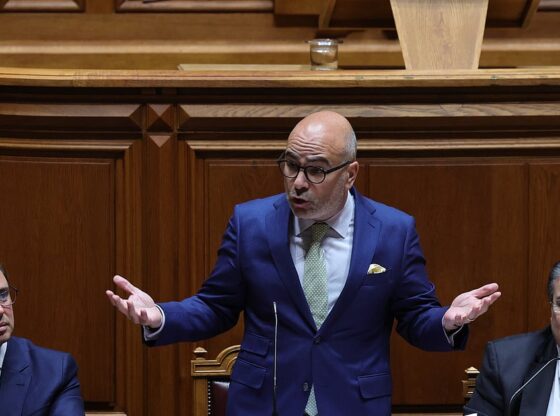

Miguel Pinto Luz, in a committee hearing at the Assembly of the Republic, did not stop at explaining TAP. The Minister of Infrastructure and Housing left the guarantee that there will be no changes in the Leiria area, with a possible replacement at the Barosa station. “There are no changes, it will be the plan that was drawn up by the Socialist Party”, adding that “it will continue until the end of 2026”.
Now, the deputies expressed concern about the delays in the tender for the High Speed line, which will also reinforce the national railway line itself in other cases.
The Soure / Carregado section includes a station in Leiria and was under public consultation until the end of March. Since then, the competition has been called for, but it has not progressed. The previous route is in the same situation, from Oiã to Taveiro, still with no visible new features. Hence the deadline proposed by Pinto Luz for the section is ambitious and generates criticism in Parliament. The plans are for the construction of the TGV line to end by 2034, but with completion from Lisbon to Madrid by 2030.
As for the controversy in Gaia, he also preferred not to fuel speculation. “I explained that a consortium, legitimately, presented a proposal. The deputy will not want me, not knowing the proposal, to IP [Infraestruturas de Portugal] being under assessment, the environment [Agência Portuguesa do Ambiente] to evaluate, Civil Protection to evaluate, to discuss with you what is fair or not fair, whether we are going to change or not change”, he said, regarding the alternative proposal for the Gaia high-speed line station, whose concession contract signed with the State defines that it will be in Santo Ovídio, with connections to two metro lines, but which the AVAN Norte consortium (Mota-Engil, Teixeira Duarte, Alves Ribeiro, Casais, Conduril and Gabriel Couto) wants to build outside of the planned location, in Vilar do Paraíso, without guarantee of construction of the respective metro extension.
The minister also highlighted negotiations with several districts to consolidate IP and invest in BRT transport, commonly known as electric buses, giving the examples of Braga and Guimarães.
The extension of the Lisbon metro was also discussed. The plans continue on a violet line to Loures, but the competent secretaries of State stressed the importance of extending the yellow line to Colégio Militar, where there will be an intersection with the blue line, and Benfica, although without connection to the train station.